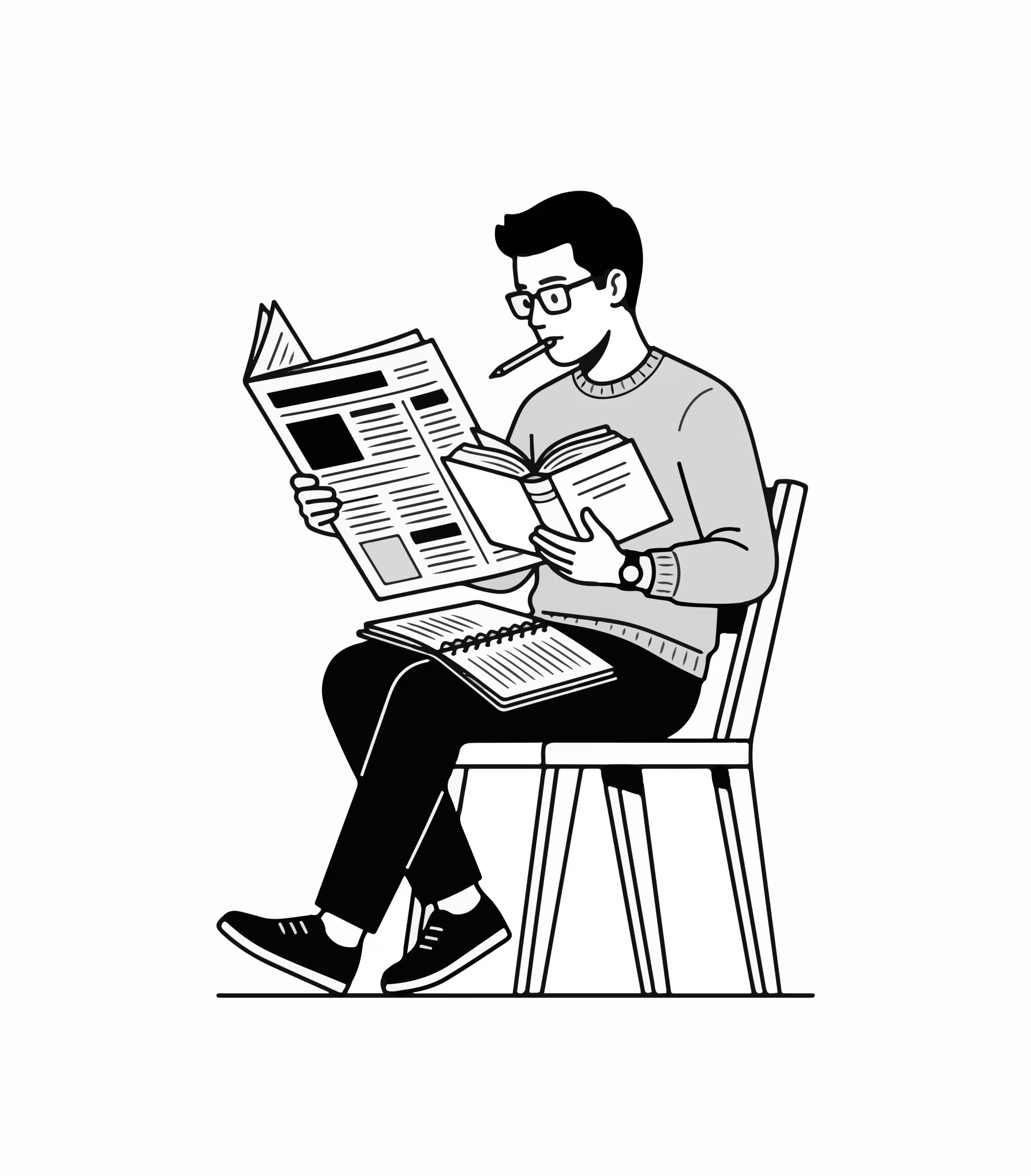
There is too much to read and too little time. Emails and texts—from friends and work associates and politicians and total strangers and would-be influencers. There is endless breaking news, available in the Antediluvian manifestation known as a newspaper, and especially online. The updates and parsing of everything from AI to midterm elections to Canadian wildfires to the evil influence of lettuce on diarrhea outbreaks—cyclosporiasis!—to the prime minister’s bloodless coup in the United Kingdom. Not to mention accounts of the many angles, far beyond soccer, associated with the recent World Cup.
And here comes this thing you’re reading now, just one more in the proliferation of Substack posts that flood inboxes. Something like a letter to an imaginary friend. Don’t be discouraged; most of those out there are fascinating, reporting and ruminating on so many levels of human existence. For me, there is plenty of content available on personal interests such as the state of journalism (the source of my employment over a half-century), grade inflation (I’m giving up my 17-year teaching gig), the disappearance of manual transmission cars (but I still have mine), arguments confronting the idea of a “just war” with Iran.
There is plenty of humor to digest and examples of optimism to be found in these dispirited times, thoughtful mullings by former colleagues and other masters of composition. So, so much to read. Attention must be paid, long past two cups of coffee each morning.
It’s ironic that, while on this hamster wheel of attempting to catch up with all the tidings and scuttlebutt and scandal (and with the conviction that I might learn something), the August issue of The Atlantic magazine arrived, announcing in its cover headline, “The Age of Reading is Over.” Author Rose Horowitch, citing the growing dominance of phone scrolling, video, X, Tik Tok and Instagram as primary information sources, posited that America hasn’t exactly devolved into being illiterate so much as becoming “postliterate.”
Which is one more topic to pore over. Horowitch noted the disappearance of newspapers as a central factor. (According to Northwestern University’s Medill School of Journalism, the United States continues to lose print newspapers at a rate of more than two per week, roughly 800 having ceased printing since 2000, while my former employer, Long Island’s Newsday, has lost 90 percent of its print circulation in less than a decade).
Horowitch wrote that “reading has come to seem extraneous even to some of the best-educated members of society,” one element leading to Donald Trump becoming “our first postliterate president,” the product of an electorate “where information is primarily spread through text.” (With questionable punctuation, according to another Atlantic piece.)
She quoted media theorist Joshua Meyrowitz’s belief that, with the decline of print media, the public shuns “authority and institutions in favor of the candidate who [makes] good television.” Voters have come to focus on “dating criteria” instead of “resume criteria” in picking their leaders.
And AI contributes enormously in threatening the “continued existence of writing,” Meyrowitz was quoted, jeopardizing critical thinking and judgement.
Still, there is no stemming the flow. In that latest Atlantic issue alone, there are 13 articles, beyond Horowitch’s, to tackle. In my house, there are roughly 500 books—probably 490 that have been read by my wife but maybe 50 by me—so there is a lot of catching up to do. It’s not as if I have the problem of that 31-year-old fellow in New York City who was faced with an eviction notice because his landlord objected to him housing 10,000 volumes in his studio apartment.
But I only now got through Richard Wright’s unsettling memoir of poverty, racism and hunger in the Jim Crow South, “Black Boy,” a mere 81 years after such an important tome was published. I didn’t get around to “War and Peace” until Covid dictated a lot of down time a couple of years ago. On another bookshelf, Shakespeare’s plays—I think our daughter read them all—seem to accusingly await my attention. As a member of my wife’s monthly library book discussion group, more immediate reading adventures also loom.
And now, with all the fuss over that new “Odyssey” movie, is there an obligation to finally read Homer’s original 3,000-year-old poem? Unless Monica Hesse unwittingly offered me absolution in a recent Washington Post column by arguing, “You can’t read everything, and it’s never too late to read something.”
OK. Bring on the words. But I do need more time.