Is anyone out there, while witnessing the athletic adventures being televised from Northern Italy, tempted to try a Winter Olympic sport? To have yourself shot out of a ski start house, over the edge of a mountain, or flung down a twisting ice tunnel, face-first, on a skeleton sled? To have a go at spins and leaps—even backflips!—on a frozen surface while balancing on thin blades of steel? To push the envelope of risk in search of potential chaos, just to see what can be done?
To mainstream American sports fans—to most American residents, in fact—we are talking about conversing in a foreign language. Pig Latin at best, and I am not claiming to be fluent.
But what if I told you I have attempted a few of these endeavors. (Well, sort of.) As a newspaper reporter who covered the Winter Games five times, I occasionally was presented with something of an Olympics-for-Dummies beginner’s course.
Figure skating. (I use the terms “figure” and “skating” loosely.) In 1994, prior to the Games in Lillehammer, Norway, Michelle Kaufman, who was the Olympic beat writer for the Detroit Free Press, organized what was the first—and, as far as I know, last—National Media Figure Skating Championships. With the usual rabble of Olympic reporters all in Motown for the U.S. Olympic figure skating trials, Kaufman arranged for the use of a rink, rental skates, even some recorded music to accompany our…ahem…routines. (We were on our own for skating outfits, which I recall ran toward sweatshirts and jeans.)
There were a couple of folks among us who actually knew what they were doing. I recall a woman who wrote for a skating magazine who was demonstrating spins and jumps, some real dipsy-doodling. But, as Randy Harvey of the Los Angeles Times noted, “We can see that at a figure skating event anytime.” He preferred the Larry-Curley-Moe bits, such as the Minneapolis Star-Tribune’s Jay Weiner shuffling around as half of a pairs team—the other half being a chair. I suspect it was not so much a prop as a device to prop him up.
Having grown up in warm-weather locales with scant experience on ice, I took a similarly safe approach. The “judges,” some Olympic coaches and officials who had joined the frivolous morning hijinks, were situated at one end of the rink, so I chose to glide—shamble? totter? lumber?—to the opposite end, whereupon I did a few ponderous back-and-forth repeats before making a quiet exit.
Listen: The Quad God was still three decades in the future, and I did avoid producing a “double cheek” (falling on my wallet). And was abundantly rewarded. One of the appointed judges, Linda Leaver, who had coached 1988 gold medalist Brian Boitano and therefore was eminently knowledgeable of all things figure skating, presented me with a perfect 6.0—the highest possible score in the sport at the time.
“I don’t know what you did,” she said. “You were too far away. I just figured it must have been okay.”
Bobsledding. In early 1993, I was assigned by Newsday to attend a session on bobsled science at the U.S. Olympic Training Center in Lake Placid, N.Y., and that weekend’s working trip was a rare opportunity to bring my wife and daughter for a little sightseeing.
It happened that conference organizers invited anyone in our group to take a bobsled run, executed—should I use that word?—in one of the older, less rapid models. So, with two professionals—one steering and the other braking—sandwiched around my wife, 13-year-old daughter and me, off we went, barreling down the icy chute at about 50 miles per hour through the half-mile plunge. Bobsledding has been described, not inaccurately, as “the champagne of thrills.”
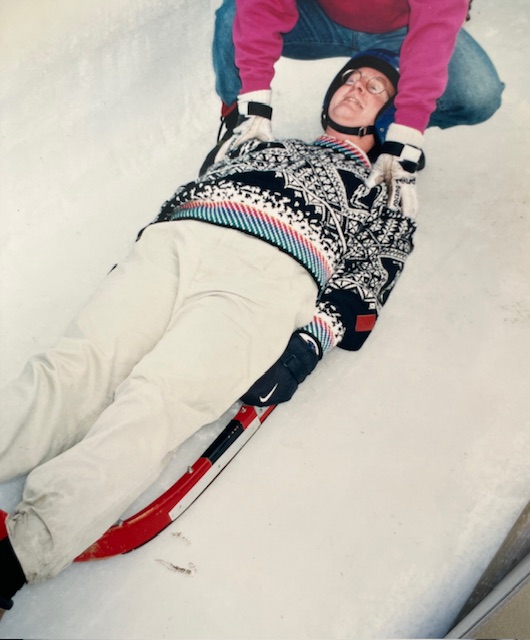
And then there was the ride on a luge.
In late 1997, prior to the 1998 Winter Games in Nagano, Japan, some of us ink-stained wretches, in town to do a bit of pre-Olympic reporting, were offered—dared?—to try out the luge track after getting brief instructions:
Lie on your back on the sled. Head back. Legs straight. Feet turned in slightly. Grab the small handles on the sled just under your knees. Though a real luger steers by subtly shifting his or her toes, barely shrugging a shoulder or ever-so-slightly lifting a knee, we were told: “Don’t do that. Don’t move. Just hang on.”
The reporter who went immediately before me—a woman I didn’t happen to know—was barely on her way when I heard her piercing screams, which didn’t stop until she had reached the bottom.
But I let them pack me on the sled, and immediately experienced that the gravity of the situation was the gravity of the situation. The luge, yanked downhill on an elevation drop of 300 to 400 feet—a bit like sailing off a 30-story building—rapidly gains momentum amid a clattering not unlike a passing train.
We amateurs had cheated that day by starting our runs halfway down the Nagano track, but were hurtling along at 40 to 45 miles per hour after just one turn—about half the speed Olympians reach—wind whistling in the ears despite a crash helmet. The real revelation was feeling, at the conclusion of the trip, completely out of breath, as if I’d sprinted down the hill rather than having laid as passively as possible on that conveyor.
Far less taxing was curling, which a handful of us journalists sampled in Salt Lake City prior to the 2002 Games. It may be worth noting that David Wallechinsky, in his series of exhaustive “Complete Books of the Olympics,” called curling a sport that “allows non-athletes to take part in the Winter Olympics.”
It’s like horseshoes or shuffleboard or bowling; requires no running or lifting or jumping. A 42-pound granite stone, resembling a tea kettle because of the shape and handle, is slid toward a bullseye-like target 146 feet away called the “house.” Teammates brush the ice in front of the moving stone; the faster they sweep, the farther the stone will go, with the intention of reaching the scoring area, maybe to guard the target against an opponent’s stone or bumping said stone out of its advantageous position.
Our experience in Salt Lake City was short-lived. My appointed teammate, with an apparent rush of adrenaline, sailed the stone so rapidly toward the house that I, at a full sprint, never caught up to it; never got close enough to apply a broom. It swept right past me.
There is a bottom line here: Some sporting activities are better for spectating than participating.