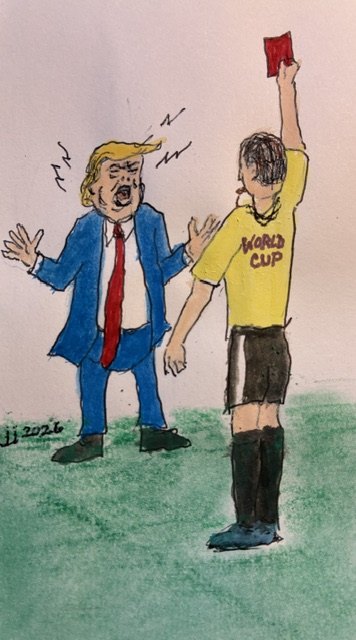
Accidentally—thanks to my wife setting the agenda—I found the ideal way to mark America’s 250th birthday weekend. Two Broadway revivals, “Ragtime” and “Death of a Salesman,” that dealt with the status of the American Dream. Plus abundant World Cup action on television that included the American nightmare of Donald Trump’s buzzkill interference in soccer protocol leading into the Yanks’ much-anticipated match against Belgium.
As a spectator sport, the theatrical performances in New York City, one a musical and the other a drama, were as exhausting as witnessing England’s survival—down a man, gasping in the heat and altitude of Mexico City, desperately holding off the home team—and Norway’s late rally against Brazil behind frightening striker Erling Haaland, and Argentina conjuring a 3-2 victory after being behind Egypt by two goals with 11 minutes to play.
Talk about fireworks.
The thing about the World Cup that clearly escapes Trump is the observation that American poet/writer Rowan Ricardo Phillips expressed in a New York Times opinion discussion, that political nationalism “too often struggles” to accept that “soccer nationalism asks you to love your side; it doesn’t require you to deny the legitimacy of the other.”
Trump’s meddling with the sport’s governing body FIFA, in overturning the red-card suspension of U.S. scoring threat Folarin Balogun, essentially took the air out of the American-Belgium tilt. And conjured the themes of both “Ragtime” and “Death of a Salesman.”
The first recalled how, at the turn of the 20th Century, the cards were stacked against Blacks and immigrants, which felt like a meditation on the Trump administration’s current priorities, the restricted Trump vision of who belongs in America. In “Wheels of a Dream,” John Clay III (as “Ragtime’s” featured Black pianist Colehouse Walker Jr., seeking dignity and justice against prominent racist attitudes), sings of his baby’s future, “When he is old enough I will show him America.”
Of course the audience could see the dead end ahead, just as for the play’s penniless Jewish artist Tateh, a proxy for the many faceless immigrants at the time. And for those now, again, in the news.
Same with the portrait in “Salesman” of Willy Loman (Nathan Lane), clearly faced with no future, relieved of his lifetime vocation, strapped for money, too proud to admit it, constantly fooling himself about his very worth. The acting—and in “Ragtime,” the dancing and singing, choreography and so on—is so energetic and emotional as to be draining, excruciating. Possibly because of a sense, 250 years on—decades since Arthur Miller wrote “Death of a Salesman” and E.L. Doctorow penned “Ragtime”—that the nation is stuck in its failure to assure that all men are treated equally and provided a realistic pursuit of happiness. Or, worse, is going backwards.
So many outside the privileged elite straining to score that elusive goal.
More from Phillips in the New York Times: “I don’t think it’s a mistake to look at the World Cup politically….What it can do, however, is show us something politics often obscures: conflict conducted under shared rules, rivalry that requires the legitimacy of the opponent, grief and joy that people enter into freely. The World Cup isn’t a mirror of politics so much as a reminder of what politics has forgotten how to stage—great acts of empathetic togetherness.”
One review of “Ragtime,” when it most recently was revived during the last presidential election, called it “apt timing for a show that rummages through an American moment to interrogate the American soul.” “Death of a Salesman,” too, examines not just where we were during its original iteration in 1949, but where the country is now.
So the Yanks lost to Belgium, with no thanks to Trump for providing the Belgians with added motivation by disregarding the rules. That particular sporting challenge, the fairly riveting World Cup action and a pair of gripping Broadway history lessons aside, it’s pretty clear we have been down this patchy road before, reminders that 250 years on, perhaps America can consider itself in stoppage time. Still, theoretically, with a shot at the universal Dream.