Category Archives: winter

To do. Or just to watch.

Is anyone out there, while witnessing the athletic adventures being televised from Northern Italy, tempted to try a Winter Olympic sport? To have yourself shot out of a ski start house, over the edge of a mountain, or flung down a twisting ice tunnel, face-first, on a skeleton sled? To have a go at spins and leaps—even backflips!—on a frozen surface while balancing on thin blades of steel? To push the envelope of risk in search of potential chaos, just to see what can be done?

To mainstream American sports fans—to most American residents, in fact—we are talking about conversing in a foreign language. Pig Latin at best, and I am not claiming to be fluent.

But what if I told you I have attempted a few of these endeavors. (Well, sort of.) As a newspaper reporter who covered the Winter Games five times, I occasionally was presented with something of an Olympics-for-Dummies beginner’s course.

Figure skating. (I use the terms “figure” and “skating” loosely.) In 1994, prior to the Games in Lillehammer, Norway, Michelle Kaufman, who was the Olympic beat writer for the Detroit Free Press, organized what was the first—and, as far as I know, last—National Media Figure Skating Championships. With the usual rabble of Olympic reporters all in Motown for the U.S. Olympic figure skating trials, Kaufman arranged for the use of a rink, rental skates, even some recorded music to accompany our…ahem…routines. (We were on our own for skating outfits, which I recall ran toward sweatshirts and jeans.)

There were a couple of folks among us who actually knew what they were doing. I recall a woman who wrote for a skating magazine who was demonstrating spins and jumps, some real dipsy-doodling. But, as Randy Harvey of the Los Angeles Times noted, “We can see that at a figure skating event anytime.” He preferred the Larry-Curley-Moe bits, such as the Minneapolis Star-Tribune’s Jay Weiner shuffling around as half of a pairs team—the other half being a chair. I suspect it was not so much a prop as a device to prop him up.

Having grown up in warm-weather locales with scant experience on ice, I took a similarly safe approach. The “judges,” some Olympic coaches and officials who had joined the frivolous morning hijinks, were situated at one end of the rink, so I chose to glide—shamble? totter? lumber?—to the opposite end, whereupon I did a few ponderous back-and-forth repeats before making a quiet exit.

Listen: The Quad God was still three decades in the future, and I did avoid producing a “double cheek” (falling on my wallet). And was abundantly rewarded. One of the appointed judges, Linda Leaver, who had coached 1988 gold medalist Brian Boitano and therefore was eminently knowledgeable of all things figure skating, presented me with a perfect 6.0—the highest possible score in the sport at the time.

“I don’t know what you did,” she said. “You were too far away. I just figured it must have been okay.”

Bobsledding. In early 1993, I was assigned by Newsday to attend a session on bobsled science at the U.S. Olympic Training Center in Lake Placid, N.Y., and that weekend’s working trip was a rare opportunity to bring my wife and daughter for a little sightseeing.

It happened that conference organizers invited anyone in our group to take a bobsled run, executed—should I use that word?—in one of the older, less rapid models. So, with two professionals—one steering and the other braking—sandwiched around my wife, 13-year-old daughter and me, off we went, barreling down the icy chute at about 50 miles per hour through the half-mile plunge. Bobsledding has been described, not inaccurately, as “the champagne of thrills.”

And then there was the ride on a luge.

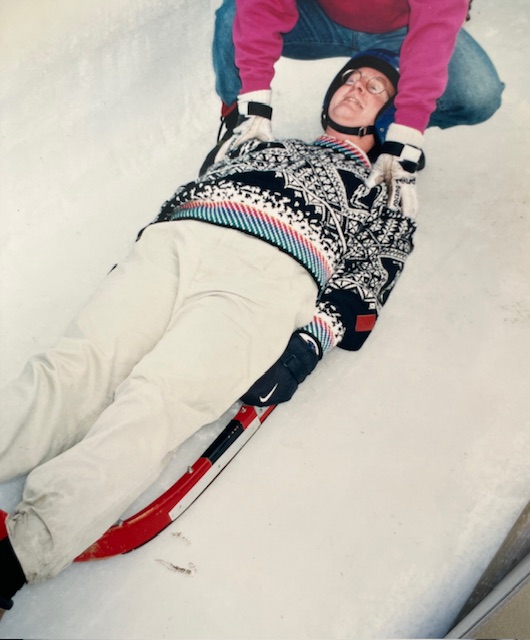
In late 1997, prior to the 1998 Winter Games in Nagano, Japan, some of us ink-stained wretches, in town to do a bit of pre-Olympic reporting, were offered—dared?—to try out the luge track after getting brief instructions:

Lie on your back on the sled. Head back. Legs straight. Feet turned in slightly. Grab the small handles on the sled just under your knees. Though a real luger steers by subtly shifting his or her toes, barely shrugging a shoulder or ever-so-slightly lifting a knee, we were told: “Don’t do that. Don’t move. Just hang on.”

The reporter who went immediately before me—a woman I didn’t happen to know—was barely on her way when I heard her piercing screams, which didn’t stop until she had reached the bottom.

But I let them pack me on the sled, and immediately experienced that the gravity of the situation was the gravity of the situation. The luge, yanked downhill on an elevation drop of 300 to 400 feet—a bit like sailing off a 30-story building—rapidly gains momentum amid a clattering not unlike a passing train.

We amateurs had cheated that day by starting our runs halfway down the Nagano track, but were hurtling along at 40 to 45 miles per hour after just one turn—about half the speed Olympians reach—wind whistling in the ears despite a crash helmet. The real revelation was feeling, at the conclusion of the trip, completely out of breath, as if I’d sprinted down the hill rather than having laid as passively as possible on that conveyor.

Far less taxing was curling, which a handful of us journalists sampled in Salt Lake City prior to the 2002 Games. It may be worth noting that David Wallechinsky, in his series of exhaustive “Complete Books of the Olympics,” called curling a sport that “allows non-athletes to take part in the Winter Olympics.”

It’s like horseshoes or shuffleboard or bowling; requires no running or lifting or jumping. A 42-pound granite stone, resembling a tea kettle because of the shape and handle, is slid toward a bullseye-like target 146 feet away called the “house.” Teammates brush the ice in front of the moving stone; the faster they sweep, the farther the stone will go, with the intention of reaching the scoring area, maybe to guard the target against an opponent’s stone or bumping said stone out of its advantageous position.

Our experience in Salt Lake City was short-lived. My appointed teammate, with an apparent rush of adrenaline, sailed the stone so rapidly toward the house that I, at a full sprint, never caught up to it; never got close enough to apply a broom. It swept right past me.

There is a bottom line here: Some sporting activities are better for spectating than participating.
Changing seasons

This is to suggest, now that the Winter Olympic Games are upon us, that these quadrennial versions of international sleigh rides and snowball fights could stand to promote more diversity, equity and inclusion. As varied as they are—featuring men and women from 92 national delegations skiing, skating, bobsledding, curling, snowboarding, biathloning across Northern Italy during the current edition—the Winter Games pretty much remain the “white man’s (and women’s) Olympics.”

Think of the not-so-wealthy countries populated by people of color. In Modern Olympic history, Cuba has won all of its 244 medals at the Summer Games. None in the Winter. Brazil (170 medals), Kenya (124), Jamaica (94), Argentina (80) have the same imbalance, with no Winter Olympic hardware.

Jamaica’s bobsled team at the 1988 Calgary Winter Olympics was an unlikely sensation, of course, inspiration for the 1993 film “Cool Runnings” and that tropical land’s first of regular Winter Games appearances. But from the original 30th-place finish in the two-man event, Jamaica’s best showing since has been no higher than 14th.

A major factor is geography, of course, and related meteorology. Live in the Alps or other snowy climes and the odds of developing one’s luge or ski-jumping skills are greatly enhanced. It’s hardly a surprise, then, that less than half the globe’s countries show up at the Winter Games, and that, according to nbcolympics.com, there were only five African nationsEritrea, Ghana, Madagascar, Morocco and Nigeria, fielding a total of six athletes—at the 2022 Beijing Winter Games. A record low. That was down from eight African countries at the 2018 Pyeongchang Olympics in South Korea.

But, wait. There is a solution to this inequity, a way of promoting marginalized countries and peoples to reach wintry Olympic heights: Move some sports from the Summer Olympic program to the Winter Games. And logically.

Basketball, for instance, is mostly contested in winter since it was created in December 1891 as a means to keep Canadian-born instructor James Naismith’s students at the Springfield, Mass., YMCA Training School fit during long New England winters. And, P.S.: When basketball made its Olympic debut at the 1936 Berlin Summer Games—outdoors—it didn’t make much sense. Especially when a pouring rain descended on the gold medal final in which the United States slogged through a 19-8 victory over Canada on a water-logged clay tennis court.

Olympic boxing certainly can happen in the wintertime. And volleyball. Wrestling. Weightlifting. Based on past results, moving those sports to the Winter Games surely would bring the first non-Summer medals to Venezuela, Cuba, Mexico, Puerto Rice, Bahamas, Chile, Dominican Republic, Indonesia and others.

It is a fact that the Olympic Charter specifies that Winter Olympic sports are to be contested on snow or ice. But need that be settled law? Especially at a time when global warming has made snow and ice harder to come by. Studies indicate that man-made snow, which has become common (and necessary) in recent Olympic cycles, exacerbates climate change, and further research warns that, without artificial snow, only four cities in the world would be capable of hosting the Winter Games by 2050.

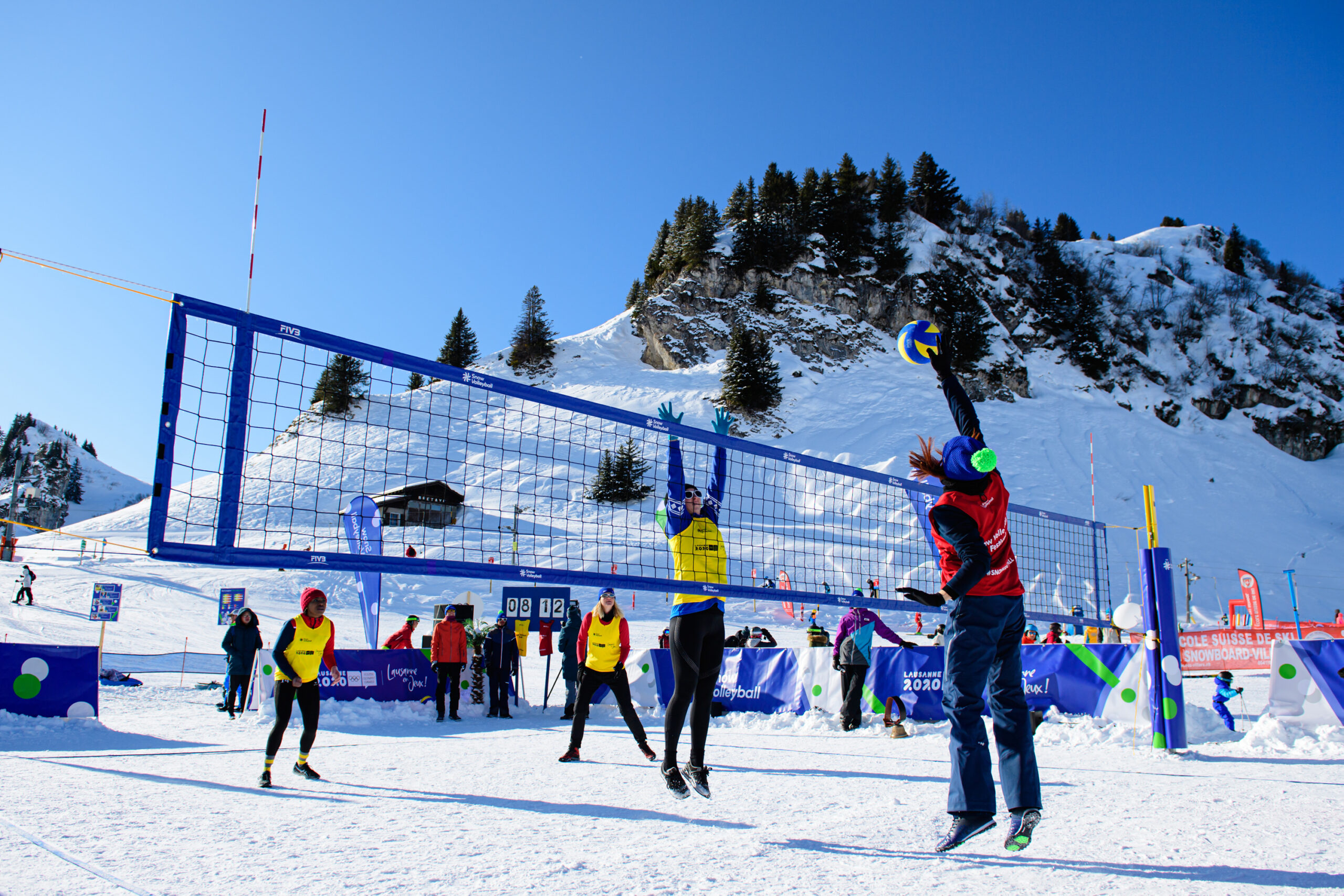
So, as the Winter Olympics continue to literally melt away, this isn’t a call for, say, boxing on ice—oh, that’s called hockey—though that might be interesting. This isn’t backing how some Olympic poohbahs have envisioned adding “snow volleyball” (quite a reverse from some chauvinist IOC member recommendations, upon the appearance of beach volleyball in the 1996 Summer Games, that it would get more attention if women should wear skimpier outfits).

Just last June, newly elected IOC president Kirsty Coventry organized a working group focused on possibly altering Winter/Summer Olympic lineups. Not exactly a push for rebranding the operation into Indoor Olympics and Outdoor Olympics, but Coventry herself is the personification of how assumptions can sometimes be misleading. A former swimming champion from Zimbabwe, Coventry’s seven medals make her Africa’s most decorated Olympian. She is white.

Anyway, Coventry’s task force has been assigned with “identifying ways for sports to be added to or removed from the program through a clear and transparent process. It will also consider the suggestion that traditional Summer or Winter sports could cross over.” Two sports that are pushing for admission into the Winter Games are cross-country running and cyclocross—neither contested on snow or ice—but clearly meant to add diversity to the Winter event. Sebastian Coe, the former Olympic middle-distance running champion who is president of track and field’s international federation, has said as much, citing cross-country in the Winter program as a way to put African athletes in position for Winter medals.

Let the Games diversify.

Olympic busking

Sure, they’re Dylan and Springsteen. That they recently were paid multiple millions for their music catalogs, well, it ain’t no use to sit and wonder why, babe. Those are songwriting giants, and you can’t start a fire without a spark.

But I’m thinking—humbly yet just out of curiosity now that the Winter Olympics again are upon us—whether the ditties I have written on Olympic topics might be worth something. To somebody.

Surely originality could get some play. The Boss, after all, never touched on the subject of ski-jumping, as I have…

On the wings of a pair of skis/These jocks show no weak knees.

They fly off with ease/On a couple of skis.

Yodel-ay-ee-hee

Yodel

Ay

Ee

Heeeeeeeeeeeeeeeeeeeeeeeeeeee

Or here’s a big-picture look at the Winter Games…

Icy rinks/Ice hills

I see some/Icy spills.

Icy nerves/Icy wills

I see great/Icy skills.

Snowy mounts/Snowy streets

‘s no easy/Snowy feats.

 Snowy skies/Snowy ground

Snowy crash/Comin’ down.

Admittedly, with these ballads, I’ve never gotten around to the music part. These are only lyrics from a poor-man’s Hammerstein in need of a Rodgers, like Bernie Taupin counting on Elton John to do the composing. But you’re got to start somewhere. I’ve read where Mick Jagger originally stuck to creating the words and letting Keith Richards supply the music.

Also, just as Bob Dylan addressed topical issues, I have dealt with matters of consequence, such as the ongoing deliberations of whether the United States ought to have skipped this year’s Beijing Games in protest of China’s human-rights violations—and the history of such actions:

It sounds like we’re fixin’/To keep right on mixin’

The politics with the sports

 Can’t say I’m surprised/But the previous tries

Left everyone tied up in knots

 Our boycott of Moscow/Wound up a fiasco

‘Cause the Reds did the same thing to us

 Just four years later/East bloc c’llaborators

Thought they’d turn LA to a bust.

A protest song? Sort of. As is this next one, calling to task the skullduggery inside the Olympic halls of power, and specifically the almost routine charges of bribery of IOC members to grant hosting rights:

Bet I can find your kid a job, if you get that guy from Guam

To cast a vote for my hometown. (Don’t say I greased your palm.)

 I hear your wife likes sable coats, and I hear you like to ski.

But I could make y’alls dreams come true. (No need for thankin’ me.)

 Just tell the guys on the I-O-C, I got the best hotels.

Got buds in bidness, gov’ment, TV. Know all the local swells.

 And if you need some surgery done, I’m friendly with the docs;

Cars and women, song and wine. I’ll pull out all the stops.

What triggered this avocation was my assignment by Newsday to cover the 1997 U.S. national figure skating championships, which were staged in Nashville, Tenn.—Music City. The constant auditory sensations there, while casually passing live honky-tonks on the way to the ice rink each day, seemed to demand an attempt at some appropriate verses and choruses. The subject matter already was staring me in the face, since the sport had been shadowed at the previous Olympics by the Tonya Harding-Nancy Kerrigan contretemps and was in great anticipation of a less dangerous Michelle Kwan-Tara Lipinski Olympic showdown in ‘98.

So my debut went something like this….

I can’t figure skating, And I can’t figure her

Slipping around with guys in sequins, Falling on their wallets with certain Frequen-

Cy

 ‘Course I’ve heard of Tonya. Heard of Nancy, too.

But this ain’t exactly stock-car racing, Ain’t football and ain’t quail-chasing, I

Guarantee.

 (Chorus)

No-knee-capping, no fist-fighting. No bad-mouthing in a bind

She’ll smile right onto that gold-medal stand, if she can just say off her behind.

 (More verses)

Is Tara in the short program? Is Michelle in the long?

Does size have something to do with things? How come there’s music but nobody sings

The songs?

 Some costumes’ll make you cry. Some’ll make you laugh.

Judges just setting there with poker faces, giving life sentences on the basis

Of a four ‘n’ a half.

 (Repeat chorus)

Okay. I am aware how relationships are prevalently featured in song. And how matters of the heart can be dealt with metaphorically. Ready? A-one and a-two…

Schussh, my darlin’, dodgin’ gates like broke promises.

Schussh, my darlin’, Harrys, Dicks, cheatin’ Thomases.

Schussh, my darlin’, love’s somethin’ like a Super G.

Schussh, my darlin’, just stay warm and don’t hit a tree.

Maybe need a little help from some fellow buskers? Take two….

Manufacturing snow: A new Winter Olympic sport?

CIMG4615

Here’s some Climate Change Denial for you: The Winter Olympics is headed to Beijing in 2022. Because of global warming, it has become difficult enough for the Winter Olympics to keep from melting away even in such climes as the Alps, Rockies and far-North Scandinavia—logical settings for an event that, by rule, is to be contested entirely on snow or ice. Yet the International Olympic Committee members, the so-called Lords of the Rings, have picked a host city historically devoid of white stuff and frozen surfaces altogether.

One report put Beijing’s annual snowfall at 5 centimeters, which isn’t quite 2 inches. Not even worth shoveling. Even Beijing’s own propaganda, used to woo IOC voters, acknowledged all its snow will have to be made artificially. Beyond meteorological deficiencies, China has virtually no tradition of either playing or watching winter sports.

So here is what’s going on: Cost overruns for host nations at Olympic Games—especially the winter version—have become so debilitating that democratic governments, faced with the reasonable concerns of their taxpayers, keep dropping out of the competition. Oslo and Stockholm, two real winter cities initially bidding for 2022, withdrew for lack of public support. That left Beijing and the Kazakhstan city of Almaty, both from nations whose authoritarian leaders do not brook NIMBY complaints.

The IOC, which at least could have gone with Almaty and its superior winter conditions and far greater winter sports interest, saw Beijing as a “safer” bet, based on Beijing’s willingness to have spent $44 billion to pull off the 2008 Summer Olympics. Spectacularly. (News accounts have made a point of Beijing becoming the first city to organize both summer and winter versions of the Games, but Stockholm—summer 1912—would have qualified for that honor as well.)

China, as Russia did in spending $50 billion on the 2014 Sochi Winter Games, wants these high-visibility events to cast itself as a can-do world power. The Olympics—increasingly just a big television show—nicely facilitates that, even though Sochi, like Beijing, is no winter resort.

Meanwhile, the Earth’s warming trends have been eating away at the snow cover needed for this quadrennial sleigh ride for decades, even in the Europeans Alps, birthplace of the Games in 1924, and home to 10 of the 22 editions. Long gone are the days when all of the competition, including ice hockey and figure skating, were contested in the great (cold) outdoors, which necessitates construction of indoor arenas and skating halls at every Olympic stop, multiplying the economic strains.

For the most recent Alps Olympics, the 2006 Turin Games, there was snow in the remote mountain venues, but only a single evening of heavy flurries in the city itself over three weeks. For precipitation, Turin got only a bit of spring-like rain….

piazza san carlo

Compare that to Albertville, France in 1992…

IMG_0789

And, especially, Lillehammer in 1994…

IMG_0792

Not since Lillehammer has there been an on-site feeling of a real Winter Olympics. Lots of snow—none of it man-made—and, better than that, a winter culture. In Norway, as an American friend observed, cross-country skiing, ski jumping and speedskating are the way the locals get to the 7-11. Winter sports are a way of life, with Norwegians reveling in the cold and snow rather than grumbling about it and trying to avoid it.

When Russia or China—even the United States, with the 2002 Salt Lake City Games—stage the Winter Olympics, they consider it important because it is the Olympics. Norway puts on the Winter Olympics and considers it important because it is winter. This visitor, sneaking hand-warmers into boots and gloves during the Lillehammer Games, was admonished by a smiling Norwegian volunteer: “That’s cheating.”

It was during the Lillehammer Games that a better idea began to circulate: Rotate the Winter Olympics among a small group of capable, already prepared winter locales. Why not hop from, say, Lillehammer to Calgary, then a site in the Alps to, possibly, Nagano, Japan (site of the 1998 Games) and back to Lillehammer?

But Juan Antonio Samaranch, the IOC president at the time, shot that down. A man who understood authoritarian governments (he had been Spain’s ambassador to the Soviet Union during Spanish dictator Generalissimo Francisco Franco’s time), Samaranch argued that the Games “belong to the world.” Although he was more than willing to let a host city work out the financial challenges on its own and leave the world—and the IOC—out of that conundrum.

In the end, having real snow is more than a matter of aesthetics, because Olympic facilities constructed for the likes of luge, bobsled, ski jumping and speedskating tend to go un-used, post-Olympics, in lands where citizens have no previous access or experience. Olympic historian David Wallechinsky, writing for the Huffington Post, last week noted how perfect Oslo 2022 would have been, “considering that Norway has earned more Winter Olympics gold medals and more total Winter medals than any other nation….”

Instead it will be China, which will have to sneak fake snow onto all those brown mountainsides (where some of the competition will be more than 100 miles from downtown Beijing). Isn’t that cheating?