Category Archives: olympics

Hockey proxy

If we’re going to hang our conviction of American exceptionalism on Olympic hockey tournament results, we at least ought to include credit to the women who also serve in that war-without-bullets.

Yes, the U.S. men this week conjured a rollicking gold-medal overtime victory over Canada, their first Olympic title since the so-called “Miracle on Ice” of 1980, a semifinal shocker over the Soviet Union, cast in the role of international menace. (Talk about a morality play!)

But it somehow was only reluctantly acknowledged by the self-appointed manly man in the Oval that the American women’s team was equally successful at the Milan Cortina Games.

In fact, if it’s global superiority Donald Trump yearns to reinforce through hockey, there is the matter of three gold medals won by the American women in eight Olympic tournament appearances, with four silver and a bronze in the other five. The U.S. men, meanwhile, now total three golds in 26 Winter Games over 106 years.

One of those successes by the guys, of course—the most recent before Sunday, 46 years ago—set off a similar beating-of-the-chests on these shores. But in far different circumstances.

In 1980, the Soviets were the established international hockey heavyweights and, on an implied level, were the athletic extension of a government considered the world’s most dangerous nuclear-age bully, its players assumed to be malevolent Communist robots.

Real enemies, if you will. Contrast that to the fact that this year’s winning American men’s goalie plays professionally in Canada, for Winnipeg, and 22 of the 25 members of the Canadian Olympic team make their living with U.S.-based teams. So this bunch of international opponents are now returning to NHL action as familiar professional teammates.

There were no NHL pros involved in ’80, the Cold War still was raging, and the Olympics—theoretically above politics but so often a proxy for ideological and political conflict—was handy for some sabre rattling and nationalistic bluster. Plus, we Yanks were hungry for some form of self-assurance, in a funk of insecurity over the Iran hostage crisis and outraged by the USSR invasion of Afghanistan two months earlier.

(Twenty-one years later, U.S. policy makers invaded Afghanistan, but that’s another story.)

So the meaning of that big game in Lake Placid was immediately inflated—perverted, really—as a representation of global pre-eminence. Herb Brooks, the U.S. coach, called his team’s 4-3 victory evidence that our way of life was better than the Soviets’. U.S. editorials declared that the hockey triumph “lifted the spirits of Americans everywhere.” The whole thing was schmaltzified—splendid hockey gone to hokey—and eventually Disneyfied in the 2004 movie “Miracle.”

Thoughtful people right after the 1980 game lamented the war mentality attached to that hockey summit, and how flimsy it was to hang one’s hat on the result of a sporting event. ABC-TV’s Jim McKay, widely respected for his work amid the Olympics’ brotherhood-of-man idealism, nevertheless hadus veered into jingoism when he signed off at the close of those Games, sounding near tears over the U.S. hockey victory. “What an Olympics!” McKay gushed. “What a country! Let’s say it here: We are a great people!”

Except: What if our hockey lads hadn’t won the Big Door Prize that winter? And what about the fact that, overall, the East Germans (23) and Soviets (22) both accumulated more medals in those Games than the Americans (12)? Were we therefore a lesser form of humans?

Plus, there was this: Because of the USSR military incursion into Afghanistan shortly before the Lake Placid Opening Ceremonies, President Jimmy Carter—who twice telephoned Herb Brooks with congratulations and called the hockey players “American heroes”—had ordered a U.S. boycott of the Summer Olympics in Moscow scheduled that summer.

A U.S. Summer Olympian, volleyball player Debbie Green, was among those outraged by the political hypocrisy. “The athletes in the Winter Games,” she said, “get all the praise for their work, and now just because our Games are in Moscow, we’re accused of being un-American” for wanting to compete.

Of course sports always is an Us-against-Them exercise. You choose your side, identify with your tribe. Here in 2026, you add Donald Trump’s Manifest Destiny pretentions and his mob-boss vision of Canada as the 51st state, wrapping himself in the flag figuratively raised by our athletes in those two Olympic finals against our Neighbors to the North.

Let’s say it here: Whatever the hockey skills and player grit at work—and the championship games were fabulous theatre on the big stage—winning Olympic gold is no test of national strength, no proof that God is on our side. The competition is Us-against-Them, but the result is not a manifestation of Good-vs.-Evil, no verification of special virtue in the United States. Or, in this case, no evidence that it is a man’s world.

As Abigail Adams cued a previous U.S. President: “Remember the ladies.”
To do. Or just to watch.

Is anyone out there, while witnessing the athletic adventures being televised from Northern Italy, tempted to try a Winter Olympic sport? To have yourself shot out of a ski start house, over the edge of a mountain, or flung down a twisting ice tunnel, face-first, on a skeleton sled? To have a go at spins and leaps—even backflips!—on a frozen surface while balancing on thin blades of steel? To push the envelope of risk in search of potential chaos, just to see what can be done?

To mainstream American sports fans—to most American residents, in fact—we are talking about conversing in a foreign language. Pig Latin at best, and I am not claiming to be fluent.

But what if I told you I have attempted a few of these endeavors. (Well, sort of.) As a newspaper reporter who covered the Winter Games five times, I occasionally was presented with something of an Olympics-for-Dummies beginner’s course.

Figure skating. (I use the terms “figure” and “skating” loosely.) In 1994, prior to the Games in Lillehammer, Norway, Michelle Kaufman, who was the Olympic beat writer for the Detroit Free Press, organized what was the first—and, as far as I know, last—National Media Figure Skating Championships. With the usual rabble of Olympic reporters all in Motown for the U.S. Olympic figure skating trials, Kaufman arranged for the use of a rink, rental skates, even some recorded music to accompany our…ahem…routines. (We were on our own for skating outfits, which I recall ran toward sweatshirts and jeans.)

There were a couple of folks among us who actually knew what they were doing. I recall a woman who wrote for a skating magazine who was demonstrating spins and jumps, some real dipsy-doodling. But, as Randy Harvey of the Los Angeles Times noted, “We can see that at a figure skating event anytime.” He preferred the Larry-Curley-Moe bits, such as the Minneapolis Star-Tribune’s Jay Weiner shuffling around as half of a pairs team—the other half being a chair. I suspect it was not so much a prop as a device to prop him up.

Having grown up in warm-weather locales with scant experience on ice, I took a similarly safe approach. The “judges,” some Olympic coaches and officials who had joined the frivolous morning hijinks, were situated at one end of the rink, so I chose to glide—shamble? totter? lumber?—to the opposite end, whereupon I did a few ponderous back-and-forth repeats before making a quiet exit.

Listen: The Quad God was still three decades in the future, and I did avoid producing a “double cheek” (falling on my wallet). And was abundantly rewarded. One of the appointed judges, Linda Leaver, who had coached 1988 gold medalist Brian Boitano and therefore was eminently knowledgeable of all things figure skating, presented me with a perfect 6.0—the highest possible score in the sport at the time.

“I don’t know what you did,” she said. “You were too far away. I just figured it must have been okay.”

Bobsledding. In early 1993, I was assigned by Newsday to attend a session on bobsled science at the U.S. Olympic Training Center in Lake Placid, N.Y., and that weekend’s working trip was a rare opportunity to bring my wife and daughter for a little sightseeing.

It happened that conference organizers invited anyone in our group to take a bobsled run, executed—should I use that word?—in one of the older, less rapid models. So, with two professionals—one steering and the other braking—sandwiched around my wife, 13-year-old daughter and me, off we went, barreling down the icy chute at about 50 miles per hour through the half-mile plunge. Bobsledding has been described, not inaccurately, as “the champagne of thrills.”

And then there was the ride on a luge.

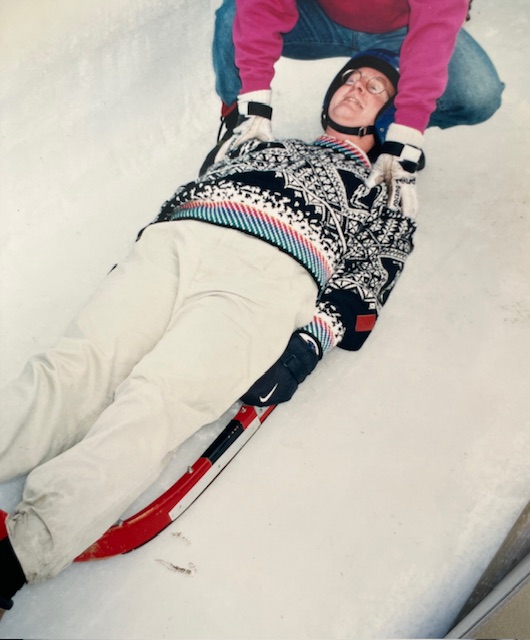
In late 1997, prior to the 1998 Winter Games in Nagano, Japan, some of us ink-stained wretches, in town to do a bit of pre-Olympic reporting, were offered—dared?—to try out the luge track after getting brief instructions:

Lie on your back on the sled. Head back. Legs straight. Feet turned in slightly. Grab the small handles on the sled just under your knees. Though a real luger steers by subtly shifting his or her toes, barely shrugging a shoulder or ever-so-slightly lifting a knee, we were told: “Don’t do that. Don’t move. Just hang on.”

The reporter who went immediately before me—a woman I didn’t happen to know—was barely on her way when I heard her piercing screams, which didn’t stop until she had reached the bottom.

But I let them pack me on the sled, and immediately experienced that the gravity of the situation was the gravity of the situation. The luge, yanked downhill on an elevation drop of 300 to 400 feet—a bit like sailing off a 30-story building—rapidly gains momentum amid a clattering not unlike a passing train.

We amateurs had cheated that day by starting our runs halfway down the Nagano track, but were hurtling along at 40 to 45 miles per hour after just one turn—about half the speed Olympians reach—wind whistling in the ears despite a crash helmet. The real revelation was feeling, at the conclusion of the trip, completely out of breath, as if I’d sprinted down the hill rather than having laid as passively as possible on that conveyor.

Far less taxing was curling, which a handful of us journalists sampled in Salt Lake City prior to the 2002 Games. It may be worth noting that David Wallechinsky, in his series of exhaustive “Complete Books of the Olympics,” called curling a sport that “allows non-athletes to take part in the Winter Olympics.”

It’s like horseshoes or shuffleboard or bowling; requires no running or lifting or jumping. A 42-pound granite stone, resembling a tea kettle because of the shape and handle, is slid toward a bullseye-like target 146 feet away called the “house.” Teammates brush the ice in front of the moving stone; the faster they sweep, the farther the stone will go, with the intention of reaching the scoring area, maybe to guard the target against an opponent’s stone or bumping said stone out of its advantageous position.

Our experience in Salt Lake City was short-lived. My appointed teammate, with an apparent rush of adrenaline, sailed the stone so rapidly toward the house that I, at a full sprint, never caught up to it; never got close enough to apply a broom. It swept right past me.

There is a bottom line here: Some sporting activities are better for spectating than participating.

Changing seasons

This is to suggest, now that the Winter Olympic Games are upon us, that these quadrennial versions of international sleigh rides and snowball fights could stand to promote more diversity, equity and inclusion. As varied as they are—featuring men and women from 92 national delegations skiing, skating, bobsledding, curling, snowboarding, biathloning across Northern Italy during the current edition—the Winter Games pretty much remain the “white man’s (and women’s) Olympics.”

Think of the not-so-wealthy countries populated by people of color. In Modern Olympic history, Cuba has won all of its 244 medals at the Summer Games. None in the Winter. Brazil (170 medals), Kenya (124), Jamaica (94), Argentina (80) have the same imbalance, with no Winter Olympic hardware.

Jamaica’s bobsled team at the 1988 Calgary Winter Olympics was an unlikely sensation, of course, inspiration for the 1993 film “Cool Runnings” and that tropical land’s first of regular Winter Games appearances. But from the original 30th-place finish in the two-man event, Jamaica’s best showing since has been no higher than 14th.

A major factor is geography, of course, and related meteorology. Live in the Alps or other snowy climes and the odds of developing one’s luge or ski-jumping skills are greatly enhanced. It’s hardly a surprise, then, that less than half the globe’s countries show up at the Winter Games, and that, according to nbcolympics.com, there were only five African nationsEritrea, Ghana, Madagascar, Morocco and Nigeria, fielding a total of six athletes—at the 2022 Beijing Winter Games. A record low. That was down from eight African countries at the 2018 Pyeongchang Olympics in South Korea.

But, wait. There is a solution to this inequity, a way of promoting marginalized countries and peoples to reach wintry Olympic heights: Move some sports from the Summer Olympic program to the Winter Games. And logically.

Basketball, for instance, is mostly contested in winter since it was created in December 1891 as a means to keep Canadian-born instructor James Naismith’s students at the Springfield, Mass., YMCA Training School fit during long New England winters. And, P.S.: When basketball made its Olympic debut at the 1936 Berlin Summer Games—outdoors—it didn’t make much sense. Especially when a pouring rain descended on the gold medal final in which the United States slogged through a 19-8 victory over Canada on a water-logged clay tennis court.

Olympic boxing certainly can happen in the wintertime. And volleyball. Wrestling. Weightlifting. Based on past results, moving those sports to the Winter Games surely would bring the first non-Summer medals to Venezuela, Cuba, Mexico, Puerto Rice, Bahamas, Chile, Dominican Republic, Indonesia and others.

It is a fact that the Olympic Charter specifies that Winter Olympic sports are to be contested on snow or ice. But need that be settled law? Especially at a time when global warming has made snow and ice harder to come by. Studies indicate that man-made snow, which has become common (and necessary) in recent Olympic cycles, exacerbates climate change, and further research warns that, without artificial snow, only four cities in the world would be capable of hosting the Winter Games by 2050.

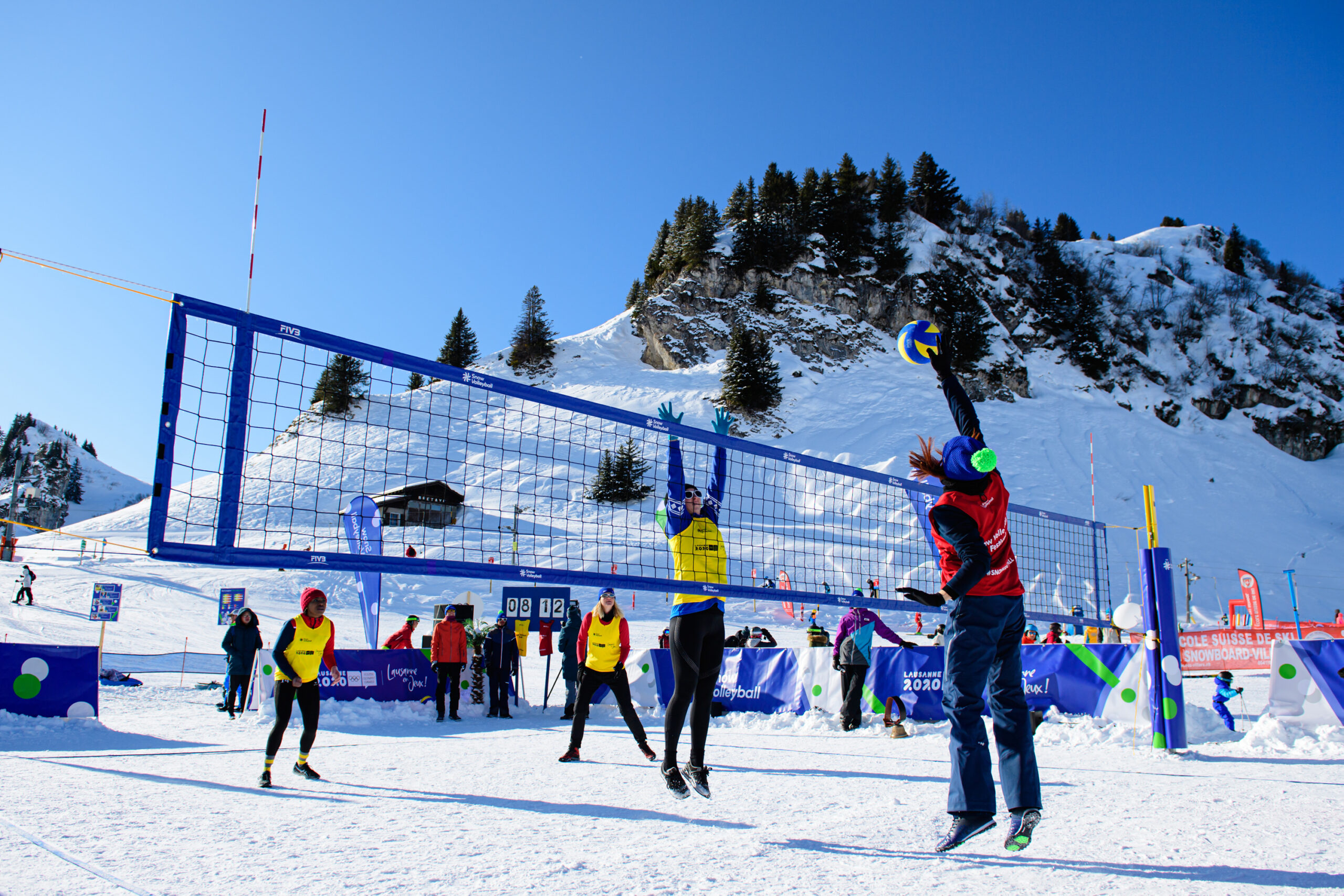
So, as the Winter Olympics continue to literally melt away, this isn’t a call for, say, boxing on ice—oh, that’s called hockey—though that might be interesting. This isn’t backing how some Olympic poohbahs have envisioned adding “snow volleyball” (quite a reverse from some chauvinist IOC member recommendations, upon the appearance of beach volleyball in the 1996 Summer Games, that it would get more attention if women should wear skimpier outfits).

Just last June, newly elected IOC president Kirsty Coventry organized a working group focused on possibly altering Winter/Summer Olympic lineups. Not exactly a push for rebranding the operation into Indoor Olympics and Outdoor Olympics, but Coventry herself is the personification of how assumptions can sometimes be misleading. A former swimming champion from Zimbabwe, Coventry’s seven medals make her Africa’s most decorated Olympian. She is white.

Anyway, Coventry’s task force has been assigned with “identifying ways for sports to be added to or removed from the program through a clear and transparent process. It will also consider the suggestion that traditional Summer or Winter sports could cross over.” Two sports that are pushing for admission into the Winter Games are cross-country running and cyclocross—neither contested on snow or ice—but clearly meant to add diversity to the Winter event. Sebastian Coe, the former Olympic middle-distance running champion who is president of track and field’s international federation, has said as much, citing cross-country in the Winter program as a way to put African athletes in position for Winter medals.

Let the Games diversify.

Greenland invades the Olympics!

It may be too late for a pair of siblings, competing in the upcoming Winter Olympics biathlon competition, to put Greenland on the map (as the illogical expression goes). Even for, say, a certain geographically challenged, arrogantly xenophobic American who doesn’t appear to know the world’s largest island (836,000 square miles) from nearby Iceland.

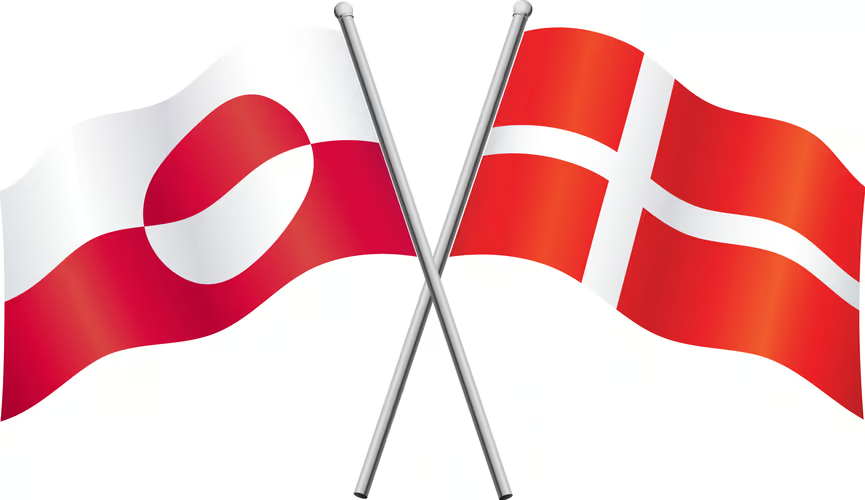
But we can hope that 24-year-old Ukaleq Slettemark and her 21-year-old brother Sondre generate some unprecedented attention for their birthplace that is enlightening. One of the grand features of the Olympics is the glimpse it can provide of generally ignored regions, their customs, history and people. If Ukaleq Slettemark, racing in her second Olympics, or her brother could somehow win a medal (though that isn’t likely), there would have to be, for instance, some public explanation of why Greenland’s red-and-white flag—the Erfalasorput, which means “our flag”—would not be raised.

Greenland has its own ski federation, founded in 1969, is a member of at least five international sports federations and competes independently at the Arctic Winter Games since their inception in 1970. But as a semiautonomous territory in the Kingdom of Denmark, and without its own national Olympic committee, Greenland’s athletes compete under Denmark’s red-and-white Nordic-cross flag, the Dannebrog.

Greenland, with only 57,000 citizens—roughly half the population of Tuscaloosa, Ala.—hardly boasts a massive talent pool, and too much attention always is paid to Olympic medal counts that mostly reflect the food chain with the largest, richest, most powerful countries on top. Yet the Slettemarks, amid the Games’ universal display of competitive joy—with which anyone, anywhere, could identify—might open a window on learning of sports in Greenland and Greenlanders’ contribution to Denmark’s Olympic participation.

Three Greenlandic skiiers were part of the Danish team at the 1998 Nagano Winter Games and one of those, Michael Binzer, got plenty of attention back home for finishing 41st in the men’s 50-kilometer cross-country freestyle event. Among the handful of Greenlanders who wore Demark’s colors in past Games was the Slettemarks’ father, Oystein, in the 2010 Vancouver Games’ biathlon event, which combines cross-country skiing and rifle shooting. The Slettemarks’ mother, Uiloq, also was a biathlete who competed in the 2012 World Championships and, on the side, founded the Greenland Biathlon Federation; she raced when she was 7 months pregnant with Ukaleq and was still active, with her husband, on the World Cup circuit in their 40s.

Here are more potential discoveries, courtesy of the Slettemarks’ Olympic presence: When Ukaleq was born, the family lived in Greenland’s capital, Nuuk, the northern-most (and one of the smallest) capital cities in the world, thought to have the highest percentage of aboriginal people in the world among its 20,000 residents. Nuuk sits on a fjord on the Southwest edge of the nation, with no roads connecting it to the rest of Greenland, though there is an international airport and boat traffic.

When she was 4, young Ukaleq was traveling widely to competitions with her parents and, since conditions for biathlon training are better in Norway, the family lived there parttime when Ukaleq first tried the sport. All were back in Greenland for the Arctic Winter Games when Ukaleq, not yet a teenager, entered the biathlon competition as a last-minute replacement. And won.

She won Greenland’s first-ever medal at a major international event with a gold in the 2019 Youth World Championships in Slovakia and made her World Cup debut in 2020 in Austria. At the 2022 Beijing Winter Olympics, she finished 53rd in the individual biathlon race and 65th in the sprint.

So it’s safe to say that the Slettemark family knows a lot more about the world than the world knows of their homeland. A recent Associated Press dispatch quoted Ukaleq’s thoughts that demonstrate she clearly has been paying attention:

–Her dream is racing “under the Greenland flag, but at the same time, I feel like everyone knows that we’re Greenlandic and we will race with our own suit that we designed with some Greenlandic markings on it,” she said. “And we feel well taken care of by the Danish Olympic Committee.”

–She works as a sustainability ambassador in the face of global warming. “I come from Greenland, I see the changes. I care about winter not disappearing.”

–And, about the deranged White House rumblings threatening ownership of Greenland: “Terrifying….I’m very good friends with the U.S. athletes. I think they’re all really nice people. [But] we’re imagining the worst-case scenario….”

She said she has heard people on the biathlon circuit hoping that, as Russia remains banned from the Olympics since its invasion of Ukraine, the same should happen if the United States attempts to forcefully take over Greenland. “I feel,” she told The AP, “more strongly connected to the Danish team because of everything that’s going on in the international politics. I think it’s really special that Greenland and Denmark stand strong together.”

There must be a lesson about allies in all this.

Give ’em a break

Here’s a workable definition of Olympic sports: Activities that are (usually) interesting to watch but virtually impossible to perform by the ordinary citizen. Ever try pole vaulting? Fencing? Marathoning? Weightlifting?

The fast-approaching 2024 Summer Olympics in Paris will provide a new example: Breakdancing. Let’s see what you have to offer in that discipline before dismissing it as not being a real sport.

Wikipedia—not that you want to put all your faith in that ubiquitous online site—declares that Olympic entry is limited to sports “based on athleticism or physical dexterity.” Which certainly would qualify breakdancing, though it should be noted that chess and bridge are among the organizations that have petitioned for Olympic recognition.

As a veteran sports journalist who has covered 11 Olympic Games, I am accustomed to—and fascinated by—the ongoing arguments and maneuvering over which endeavors deserve Olympic inclusion.

In his enlightening Sports Illustrated report on the 1972 Olympic Marathon, in which he finished fourth, Kenny Moore noted that even some athletes sometimes questioned the comparative validity of fellow participants. Moore quoted an American rower contending he found it “hard to call people in yachting, equestrian and maybe shooting real Olympians. In my mind an Olympian is an individual who approaches the limits of human performance. That entails enduring a kind of pain that you don’t get riding in a sailboat.”

There have been arguments that Olympic poohbahs ought to raise the drawbridge and refuse to let in any more events. And, indeed, the Games have been struggling with the problem of gigantism for some time—how to organize and fund a 17-day festival which, in its Summer iteration, must accommodate in excess of 11,000 participants, with all the attendant issues of facilities, housing, transportation and so on.

Opposition exists to welcoming perceived “trash sports”—except: who defines what is a trash sport? Might that be any exhibition staged solely for the purpose of being televised, featuring participants whose only qualification is being celebrities? It must be acknowledged that there is no doubt the Olympics is bullish on getting more eyeballs, reaching new fans and thereby banking more TV money.

There have been efforts, for a long time, to get ballroom dancing into the Games—an activity which, frankly, doesn’t seem to be as physically demanding as breakdancing, since ballroom dancers never spin on their heads or strike one-arm handstands. And what about bocce? Bowling? Aerobics? All of them are interested in inclusion.

If sport climbing, rugby and surfing—all new Olympic sports—were lumped under one umbrella of competition, along with the proposed acceptance of cricket, flag football, lacrosse and squash, they could fit the generic description once suggested by a fellow Olympic reporter: Horsing Around.

Times change. Croquet was in the 1900 Paris Games. (And featured the first appearance of women in the modern Olympics.) Golf showed up in 1900 and ’04, then disappeared until 2016. Jeu de Paume, forerunner to modern tennis, was in the 1908 London Games. Motor boating was included in 1904 and ’08. Polo from 1900 through 1936, when the gold-medal final drew 45,000 spectators. Tug of War—now, that entails more pain than riding in a sailboat—was contested from 1900 through 1920.

It could be argued that opposition to some sports is a function of close-minded, provincial judgement that fails to take in different regional tastes and cultural influences. Table tennis? Big in Korea, as is badminton in China, field hockey in the Netherlands and Germany, volleyball in Brazil. Taekwondo, introduced at the ’88 Seoul Games, is widely followed in Korea. Cricket, returning to the Games in 2028 after a 128-year absence, originally was spread by the world-conquering British empire and now has a rabid following throughout South Asia; any India vs. Pakistan cricket match is of Super Bowl importance to citizens of those nations. The only sport more popular in more countries than cricket is soccer.

And the major reason that American football never has been part of the Olympic show is because only one nation embraces it as its No. 1 sport. So it’s not as if there is no reason or rhyme to Olympic acceptance of sports.

Back to Wikipedia, which considers sport to be “any form of physical activity or game, often competitive and organized, that aims to use, maintain or improve physical ability and skills while providing enjoyment to participants and, in some cases, entertainment to spectators.”

So bring on breakdancing, which originated in the Black and Puerto Rican communities of New York City and has expanded globally, promoted by the World Dance Sport Federation. It is road tested, with an array of organizations and competitors “from Switzerland to Kazakhstan” at a recent international competition, according to ESPN.

No need to be fully conversant in breakdancing lingo—toprocks, downrocks, freezes and so on. If you must, think of it as another elite form of horsing around. It’s going to be interesting to watch.

Miraculous staying power

Do you believe in nostalgia?

Visit Lake Placid, N.Y., and you will be immersed in countless references, souvenirs and images recalling the moment in sports history when sportscaster Al Michaels hyperbolically asked 34 million American viewers, “Do you believe in miracles?”

It’s a central feature in the village’s international claim to fame as Winter Olympic host. It was a long time ago—43 years—before more than half of the world population was born. But, still: Approaching upstate Lake Placid now from the main road off the New York Thruway, one can’t avoid the various 1980 Olympic sites—the Mount Van Hoevenberg complex with its bobsled and luge run, the biathlon venue, the Olympic ski jump.

At the village’s southern edge, there are the flying flags from the 1980 participating Olympic nations, as if those Games still were going on, just outside the speed skating oval where American Eric Heiden won five gold medals, and adjacent to the imposing Olympic Center that includes two hockey arenas—from the two Lake Placid Winter Games, in 1932 and 1980—situated, naturally, at “Miracle Plaza.”

It has been more than a decade since the New York Times noted how Lake Placid “can feel cryogenically frozen in time—1980 to be exact, which was when this secluded pocket of the Adirondacks hosted its second Winter Olympics” yet continued to “look much as it did when Jimmy Carter was in office.”

And still: Forty-three years on, around town there are pictograms of the various Winter Olympic sports displayed on buildings; an old bobsled perched on a sidewalk; 1980 Olympic jerseys, signed by members of that winter’s U.S. team, hung in hotel lobbies; rows of shops with sweatshirts and caps adorned with 1980 logos; the local newspaper’s masthead proclaiming Lake Placid “host of the 1932 and 1980 Olympic Winter Games;” books and memorabilia chronicling the so-called 1980 “Miracle on Ice.”

On Labor Day weekend—this Labor Day, 2023—the Adirondack Daily Enterprise and the weekly Lake Placid News both ran reports on New York senator Kirsten Gillibrand’s recent visit to Lake Placid and her specific recollections of that “miracle” 1980 semifinal ice hockey victory by the underdog Americans over the Soviets. Gillibrand even noted that her parents had attended the game. Which apparently prompted current Olympic Regional Development Authority board president Joe Martens’ aside that “It’s kind of a running joke in Lake Placid—there were 8,500 people in here for the game but 30,000 people say they were here.”

It was just a hockey game. But it featured a shocking upset by a rag-tag team of American amateurs over the four-time reigning gold medalists from the old Soviet Union. And amid Cold War tensions, the Yanks’ thoroughly unlikely upset of the so-called Evil Empire was widely cast as a victory for righteousness, somehow evidence of Americans’ morality, and as the game’s final seconds ticked away, Michaels laid it on pretty thick with his “miracles” question.

Forty-three years ago. Sooo yesterday, no? Yet the Lake Placid of 2023 hardly has a Paleolithic feel; rather, it is a thoroughly up-to-date, scenic burg, alive with flora and fauna, centered by serene Mirror Lake with the Adirondack Mountains as a picturesque backdrop.

It teems with energy—joggers, swimmers, dog walkers, baby strollers, kayakers and cyclists—and with community affairs such as the I Love BBQ and Music Festival Weekend surrounding Labor Day, and a state golf championship for seniors and “superseniors” (65-plus).

It’s just that village leaders know how their bread is buttered. So, along with the ongoing Olympic reminiscence is the continued outreach for similar—if less famous—international winter competitions such as last February’s World University Winter Games and next month’s World Figure and Fancy Skating Championships, in which competitors form artistic squiggles on black ice.

The local population is not quite 2,500 but there are year-round crowds of tourists, many speaking in foreign tongues, lured by the village’s international renown and resort status.

“If the town were not smothered in Olympic logos,” the long-ago Times travel piece reported, “visitors might forget about its Olympic connections and think they had wandered into an idyllic Swiss hamlet.

Not likely, that. The miracle has been held over by popular demand.

Once teammates

Try finding the land of The Unified Team on an old map, circa 1992. Or the Commonwealth of Independent States. It’s a challenge that relates to the sudden discovery by many people of just where Ukraine is.

Here’s a big hint: Thirty years ago, the UT and the CIS represented an ad-hoc “nation” that had just evolved from what Ronald Reagan previously labeled “the evil empire” and that the soulless despot Vladimir Putin now wants to revive—the Soviet Union.

As the USSR fell apart in the early ‘90s, though, there came to be an apparently benign one-for-all and all-for-one arrangement, with all former Soviets staying temporarily on the same team. Just the opposite of how Putin is acting on his claim that “Russians and Ukrainians are one people” by having his Russian military murder Ukrainians.

This is a sports story, of sorts. But one which reminds how sports—like the arts and business worlds—are tangled up in government actions. Russia’s unprovoked invasion of its neighbor already has gotten athletes from Russia (and Belarus, because of that nation’s aid in the Russian attack) banned from the Paralympic Games, the upcoming World Games and events in international figure skating, ice hockey, swimming, skiing, badminton, canoeing, equestrian, gymnastics, rowing, rugby, shooting—even chess. Russia has been thrown out of soccer’s World Cup qualifying tournament while tennis has declared that Russian and Belarussian athletes only are welcome as “neutral” participants, minus their national affiliations.

But about the comparison from three decades ago. Following closely on the declaration of independence by the three Baltic states—Estonia, Latvia and Lithuanian—the USSR’s dissolution in late 1991 meant that the globe’s biggest sports stage, the Olympics, was scrambling to accommodate Russia and 12 former Soviet republics for the 1992 Albertville Winter Games.

The solution was to have athletes from those republics continue to participate on the Russian side (which didn’t stray far from an old and widespread assumption that all Soviets were Russian). Thus the one-time-only Olympic squad known as The Unified Team, representing the Commonwealth of Independent States. (Some of us wise-guy Westerners, having come from the other side in the Cold War, referred to them in shorthand as “The Commies.”)

The revealing aspect was how non-Russian Unified Teamers expressed a feeling of lost identity. All marched and received medals under the Olympic flag and with the Olympic anthem, and among the gold medalists who found the situation wanting was pairs skating champion Natalia Mishkutienok, a Belarussian who teamed with Ukrainian Artur Dmitriev.

The situation was “not good,” she said. “I like the Russian anthem and I like the Russian flag.” (Of course she meant the Soviet song and the red hammer-and-sickle USSR flag.) Viktor Petrenko, a Ukrainian who won the ’92 men’s skating title, said after his victory ceremony, “I want to see some flag. The Ukraine flag or Russian flag, that would be better.”

There were bad jokes about The Unidentified Team and how it had no fight song, no team pennant.

Petrenko wore warmups emblazoned with CCCP, the Cyrillic abbreviation for USSR. His official Olympic “identity record” listed his age as 22, his birth date as 6/17/69, his town of birth as “Odessa,” his country of birth as “Unified Team” and his nationality as “Unified Team.”

“We are still a team,” Petrenko said then. “We are still teammates. Everything’s the same like that. We just represent different republics. I really don’t know what’s going on in my country. But we’re still a team.”

All Unified Teamers had held aloft tiny flags representing their respective republics in the Opening Ceremonies and wore their individual country’s flag patches during the Games. Outside the Olympic skating hall, a sign soon appeared offering “for sale: Soviet training suits. All stock must go.” CCCP warmups were selling for $150 apiece.

Some Unifieds meanwhile found humor in the no-longer applicable words to the Soviet anthem…

Unbreakable Union of freeborn Republics

Great Russia has welded forever to stand.

Created in struggle by will of the people.

United and mighty, our Soviet land!

The “unbreakable union” was broken. And Putin’s attempts to put it back together by force after 30 years don’t appear to be going so well, in the one-team sense. A recent report noted that, among the Ukrainian citizens trapped in their native land by the Russian bombardment is Viktor Petrenko, the old skating champion from The Unified Team.

He was said to be in Kyiv, the capital. It’s on the map. And it was Mark Twain’s unsettling observation that “God created war so Americans would learn geography.”


Torched!

As an Olympic postscript, consider IOC president Thomas Bach’s wacky offer of holdover gifts for victims of the fathomless ruling that allowed Russian teenager Kamila Valieva’s continued eligibility despite a failed drug test.

Bach wound up acknowledging the dystopian conclusion to the figure-skating circus after Valieva fell apart, was berated by her coach and left one of her medal-winning teammates enraged and the other virtually ignored. That the heavily favored Valieva crashed to fourth place in the individual final at least spared Bach’s IOC the embarrassment of having to cancel that discipline’s awards ceremony.

But an official verdict—and the inevitable appeals—on the legitimacy of Russia’s earlier Valieva-led first place in team skating could take months. And with all medals in that team event meanwhile held in escrow, Bach suggested giving each athlete for second-place U.S. and third-place Japan an Olympic torch.

Goofy, no? There was no word regarding torches for the Canadians, who were fourth but, if the Russians ultimately are disqualified, would become bronze medalists, with the Japanese upgraded to silver and the Americans to gold. (There was confirmation that the U.S. skaters’ request for the temporary possession of silver medals was denied.)

Of course, no Russians should have been on the scene in the first place. The IOC’s clumsy wrist slap for Russia’s state-sponsored doping program in the 2014 Sochi Games somehow has resulted only in a ban of Russia’s flag and anthem in the four subsequent Olympics. Yet Russian athletes again were everywhere in Beijing, totaling the second-highest accumulation of hardware.

And most visible was Valieva, with a Court of Arbitration for Sport panel making matters worse by illogically reasoning that “irreparable harm” would be done to her if she couldn’t proceed in the free skate. That led to Valieva’s messy, distracted routine and the shunning by her entourage, which Slate’s Chris Schleicher wrote was “not only irreparable harm to Valieva but also to the sport of figure skating.” And, by extension, to the Olympics, since women’s figure skating is the Winter Games’ biggest show.

She’s only 15. There’s a good chance Valieva’s handlers had responsibility in the scandal, though there also was her weird claim of having been contaminated unintentionally by her grandfather’s heart medicine.

Whatever. Former anti-doping expert Don Catlin used to note that a positive drug test doesn’t profess to determine culpability—“We can’t know what’s in athletes’ heart or mind, only what’s in their bodies.” A failed test is a failed test and, according to the rules, requires a suspension.

But about those torches. Bach was referring to the cone-shaped objects, designed and produced each Olympic cycle, in which the Olympic flame is ceremoniously carried by thousands of runners from the site of the ancient Games in Olympia, Greece, to the host city. Typically, the torch relay covers more than 100 days through multiple nations leading up to the competition; it took 138 days for Beijing’s 2008 Summer Games. But, this year, because of the pandemic, a late decision drastically restricted the relay to just three days, confined to the Beijing area.

That means there probably are a lot of torches just lying around unused. (For the 2008 Beijing Summer Games, 26,440 torches were produced; there is no information on the total this time.) And that tends to reduce torch ownership to something akin to a widely-available souvenir—on the order of Olympic trading pins.

Even I have an Olympic torch. (I was among the handful of foreign journalists asked to run in the 1988 Seoul Olympics torch relay, when organizers wanted a mix of international participants and media folks could be counted on to be in the country before the Games.) Somehow, it’s hard to image that trinket as a replacement for an Olympic medal.

Thomas Bach is himself the possessor of an Olympic medal for being part on a winning team—West Germany’s fencers in the foil discipline—at the 1976 Montreal Games. Surely he knows what that prize is worth to an athlete. Maybe he ought to agitate for hanging a badge of guilt around the necks of all scoundrels involved in Russia’s state-run doping system. To keep them—not just their flags and anthems—outside the Olympic gates.

Olympic busking

Sure, they’re Dylan and Springsteen. That they recently were paid multiple millions for their music catalogs, well, it ain’t no use to sit and wonder why, babe. Those are songwriting giants, and you can’t start a fire without a spark.

But I’m thinking—humbly yet just out of curiosity now that the Winter Olympics again are upon us—whether the ditties I have written on Olympic topics might be worth something. To somebody.

Surely originality could get some play. The Boss, after all, never touched on the subject of ski-jumping, as I have…

On the wings of a pair of skis/These jocks show no weak knees.

They fly off with ease/On a couple of skis.

Yodel-ay-ee-hee

Yodel

Ay

Ee

Heeeeeeeeeeeeeeeeeeeeeeeeeeee

Or here’s a big-picture look at the Winter Games…

Icy rinks/Ice hills

I see some/Icy spills.

Icy nerves/Icy wills

I see great/Icy skills.

Snowy mounts/Snowy streets

‘s no easy/Snowy feats.

 Snowy skies/Snowy ground

Snowy crash/Comin’ down.

Admittedly, with these ballads, I’ve never gotten around to the music part. These are only lyrics from a poor-man’s Hammerstein in need of a Rodgers, like Bernie Taupin counting on Elton John to do the composing. But you’re got to start somewhere. I’ve read where Mick Jagger originally stuck to creating the words and letting Keith Richards supply the music.

Also, just as Bob Dylan addressed topical issues, I have dealt with matters of consequence, such as the ongoing deliberations of whether the United States ought to have skipped this year’s Beijing Games in protest of China’s human-rights violations—and the history of such actions:

It sounds like we’re fixin’/To keep right on mixin’

The politics with the sports

 Can’t say I’m surprised/But the previous tries

Left everyone tied up in knots

 Our boycott of Moscow/Wound up a fiasco

‘Cause the Reds did the same thing to us

 Just four years later/East bloc c’llaborators

Thought they’d turn LA to a bust.

A protest song? Sort of. As is this next one, calling to task the skullduggery inside the Olympic halls of power, and specifically the almost routine charges of bribery of IOC members to grant hosting rights:

Bet I can find your kid a job, if you get that guy from Guam

To cast a vote for my hometown. (Don’t say I greased your palm.)

 I hear your wife likes sable coats, and I hear you like to ski.

But I could make y’alls dreams come true. (No need for thankin’ me.)

 Just tell the guys on the I-O-C, I got the best hotels.

Got buds in bidness, gov’ment, TV. Know all the local swells.

 And if you need some surgery done, I’m friendly with the docs;

Cars and women, song and wine. I’ll pull out all the stops.

What triggered this avocation was my assignment by Newsday to cover the 1997 U.S. national figure skating championships, which were staged in Nashville, Tenn.—Music City. The constant auditory sensations there, while casually passing live honky-tonks on the way to the ice rink each day, seemed to demand an attempt at some appropriate verses and choruses. The subject matter already was staring me in the face, since the sport had been shadowed at the previous Olympics by the Tonya Harding-Nancy Kerrigan contretemps and was in great anticipation of a less dangerous Michelle Kwan-Tara Lipinski Olympic showdown in ‘98.

So my debut went something like this….

I can’t figure skating, And I can’t figure her

Slipping around with guys in sequins, Falling on their wallets with certain Frequen-

Cy

 ‘Course I’ve heard of Tonya. Heard of Nancy, too.

But this ain’t exactly stock-car racing, Ain’t football and ain’t quail-chasing, I

Guarantee.

 (Chorus)

No-knee-capping, no fist-fighting. No bad-mouthing in a bind

She’ll smile right onto that gold-medal stand, if she can just say off her behind.

 (More verses)

Is Tara in the short program? Is Michelle in the long?

Does size have something to do with things? How come there’s music but nobody sings

The songs?

 Some costumes’ll make you cry. Some’ll make you laugh.

Judges just setting there with poker faces, giving life sentences on the basis

Of a four ‘n’ a half.

 (Repeat chorus)

Okay. I am aware how relationships are prevalently featured in song. And how matters of the heart can be dealt with metaphorically. Ready? A-one and a-two…

Schussh, my darlin’, dodgin’ gates like broke promises.

Schussh, my darlin’, Harrys, Dicks, cheatin’ Thomases.

Schussh, my darlin’, love’s somethin’ like a Super G.

Schussh, my darlin’, just stay warm and don’t hit a tree.

Maybe need a little help from some fellow buskers? Take two….

Using the Olympic soapbox

(A shorter version of this appeared in Newsday’s Opinion pages)

Will anybody really notice when President Biden and other high-ranking U.S. officials don’t show up for February’s Winter Olympics in Beijing? The Biden Administration’s declaration of a diplomatic boycott of the Games expressly allows athletes to compete in China, so the quadrennial shushing, sliding and skating among the world’s sportswomen and sportsmen will proceed with great fanfare and with NBC’s typically melodramatic presentation. Curling fans will not be robbed of their exotic brand of entertainment.

So: Does such a high-level snub accomplish anything?

The White House has declared its action as an objection to the Chinese government’s “ongoing genocide and crimes against humanity” and other abuses, including a crackdown of freedoms in Hong Kong and Tibet and the recent disappearance of Chinese tennis star Peng Shuai after she accused a high-ranking Communist official of sexual assault.

It’s clear that China doesn’t much worry about criticism from the West. And Olympic boycotts historically have not been an effective tool in reforming nefarious behavior. The 1980 U.S.-led boycott of the Moscow Summer Games, called by President Jimmy Carter and joined by 64 other nations protesting the 1979 Soviet invasion of Afghanistan, outraged the athletes who felt they were pawns, and it had no impact on the Soviet occupation, which lasted another nine years. About all it accomplished was the Soviets’ revenge boycott of the Los Angeles Games four years later which again was foisted upon non-voting athletes.

The argument here is that, while the President’s declaration is essentially a symbolic one, it nevertheless is generating an abundance of commentary and likely some discomfort for the corporate giants helping to bolster Beijing and the International Olympic Committee. And, in doing so, it is highlighting the feeble stance on human rights by the International Olympic Committee, which promotes a mission of global goodwill through a sort of United Nations in Sneakers.

The IOC awarded the 2008 Summer Olympics to Beijing, in spite of China being one of the world’s most repressive governments, amid global protests that included pleas at the time for a full boycott. When that threat passed and the competition began, all the focus went to the athletes and China’s spectacularly run events. Then the IOC favored Russia with the 2014 Winter Games in the face of complaints about Moscow’s anti-gay legislation. And Beijing was chosen again for 2022.

Each instance violated language in Provision 6 of the IOC charter requiring Olympic hosts to insure that “rights and freedoms….shall be secured without discrimination of any kind, such as race, color, sex, sexual orientation, language, religion, political or other opinion, national or social origin, birth or other status.”

Called out again for ignoring such policies, both Beijing and the IOC predictably are bemoaning the United States’ proposed diplomatic action by invoking the old sports-and-politics-shouldn’t-mix cliché—when, in fact, sports and politics always are mixed. Especially with the Olympics, which has become the world’s biggest soapbox, playing to the grievances of dissidents and the self-interest of image-makers every bit as much as the guardians of carefree sport.

Every Olympics site has served as a political statement by the host, whether it was Nazi Germany’s 1936 Games as propaganda for Hitler’s criminal agenda, Japan’s 1964 Olympics to demonstrate its post-World War II revival, South Korea’s 1988 Games to showcase a turn to democracy, even L.A.’s 1984 celebration of capitalist might. China wants to telegraph its technological and economic power and, not least, an athletic prowess in the familiar, if illogical, assumption that gold medals suggest a nation’s moral superiority.

Naturally, since the core of the Olympics is sport, the athletes prioritize competition but, increasingly, they may not just shut and play. Several U.S. Olympians, including figure skaters Evan Bates and Nathan Chen, have confirmed their participation while condemning China’s human rights violations as “abysmal,” and the U.S. Olympic and Paralympic Committee declared last year that it would not punish its jocks for reasonable demonstrations during the Games. (The IOC, citing its old rule limiting “athlete expression,” said it will.)

So neither Biden nor vice president Kamala Harris nor any department secretaries will join the hullabaloo in February. And China won’t change its spots. But we’ve been forced to think about the issue now.