It may be too late for a pair of siblings, competing in the upcoming Winter Olympics biathlon competition, to put Greenland on the map (as the illogical expression goes). Even for, say, a certain geographically challenged, arrogantly xenophobic American who doesn’t appear to know the world’s largest island (836,000 square miles) from nearby Iceland.
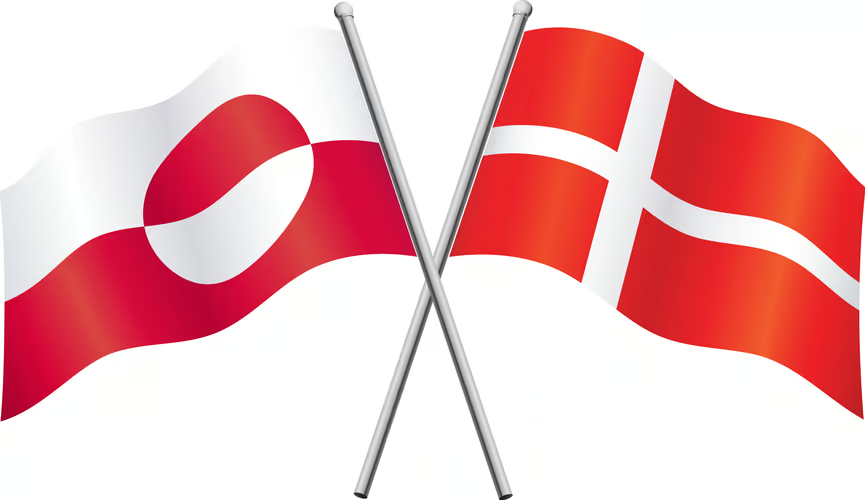
But we can hope that 24-year-old Ukaleq Slettemark and her 21-year-old brother Sondre generate some unprecedented attention for their birthplace that is enlightening. One of the grand features of the Olympics is the glimpse it can provide of generally ignored regions, their customs, history and people. If Ukaleq Slettemark, racing in her second Olympics, or her brother could somehow win a medal (though that isn’t likely), there would have to be, for instance, some public explanation of why Greenland’s red-and-white flag—the Erfalasorput, which means “our flag”—would not be raised.
Greenland has its own ski federation, founded in 1969, is a member of at least five international sports federations and competes independently at the Arctic Winter Games since their inception in 1970. But as a semiautonomous territory in the Kingdom of Denmark, and without its own national Olympic committee, Greenland’s athletes compete under Denmark’s red-and-white Nordic-cross flag, the Dannebrog.
Greenland, with only 57,000 citizens—roughly half the population of Tuscaloosa, Ala.—hardly boasts a massive talent pool, and too much attention always is paid to Olympic medal counts that mostly reflect the food chain with the largest, richest, most powerful countries on top. Yet the Slettemarks, amid the Games’ universal display of competitive joy—with which anyone, anywhere, could identify—might open a window on learning of sports in Greenland and Greenlanders’ contribution to Denmark’s Olympic participation.
Three Greenlandic skiiers were part of the Danish team at the 1998 Nagano Winter Games and one of those, Michael Binzer, got plenty of attention back home for finishing 41st in the men’s 50-kilometer cross-country freestyle event. Among the handful of Greenlanders who wore Demark’s colors in past Games was the Slettemarks’ father, Oystein, in the 2010 Vancouver Games’ biathlon event, which combines cross-country skiing and rifle shooting. The Slettemarks’ mother, Uiloq, also was a biathlete who competed in the 2012 World Championships and, on the side, founded the Greenland Biathlon Federation; she raced when she was 7 months pregnant with Ukaleq and was still active, with her husband, on the World Cup circuit in their 40s.
Here are more potential discoveries, courtesy of the Slettemarks’ Olympic presence: When Ukaleq was born, the family lived in Greenland’s capital, Nuuk, the northern-most (and one of the smallest) capital cities in the world, thought to have the highest percentage of aboriginal people in the world among its 20,000 residents. Nuuk sits on a fjord on the Southwest edge of the nation, with no roads connecting it to the rest of Greenland, though there is an international airport and boat traffic.
When she was 4, young Ukaleq was traveling widely to competitions with her parents and, since conditions for biathlon training are better in Norway, the family lived there parttime when Ukaleq first tried the sport. All were back in Greenland for the Arctic Winter Games when Ukaleq, not yet a teenager, entered the biathlon competition as a last-minute replacement. And won.
She won Greenland’s first-ever medal at a major international event with a gold in the 2019 Youth World Championships in Slovakia and made her World Cup debut in 2020 in Austria. At the 2022 Beijing Winter Olympics, she finished 53rd in the individual biathlon race and 65th in the sprint.
So it’s safe to say that the Slettemark family knows a lot more about the world than the world knows of their homeland. A recent Associated Press dispatch quoted Ukaleq’s thoughts that demonstrate she clearly has been paying attention:
–Her dream is racing “under the Greenland flag, but at the same time, I feel like everyone knows that we’re Greenlandic and we will race with our own suit that we designed with some Greenlandic markings on it,” she said. “And we feel well taken care of by the Danish Olympic Committee.”
–She works as a sustainability ambassador in the face of global warming. “I come from Greenland, I see the changes. I care about winter not disappearing.”
–And, about the deranged White House rumblings threatening ownership of Greenland: “Terrifying….I’m very good friends with the U.S. athletes. I think they’re all really nice people. [But] we’re imagining the worst-case scenario….”
She said she has heard people on the biathlon circuit hoping that, as Russia remains banned from the Olympics since its invasion of Ukraine, the same should happen if the United States attempts to forcefully take over Greenland. “I feel,” she told The AP, “more strongly connected to the Danish team because of everything that’s going on in the international politics. I think it’s really special that Greenland and Denmark stand strong together.”
There must be a lesson about allies in all this.