
It’s a calumny. A slander. Also, pure fiction.
According to the A.I. Overview that pops up on Google, yours truly “did not finish or officially run the May 7, 2017 Long Island Half Marathon.” That A.I. summary, which inaccurately plagiarized sections of my own account of the event, insists that “Jeansonne…explicitly noted on his personal blog that he did not attempt running the 13.1-mile race that year. He jokingly shared that he…had no desire to take on such a physical challenge at age 70” because he is “opposed to torture in all its forms…”
What I actually wrote (and what appeared in a Newsday geezer column as well as on my website) started like this:
Just to be clear: I did not attempt running the May 7 Long Island Half Marathon—13.1 miles—as some death-defying challenge at 70….
But quickly clarified:
…let me report that I did not suffer. Unless one considers the uncomfortable realization that with age comes a significant fading of muscle memory. Leg oldsheimer’s. What took me an hour and 36 minutes when I was 39; what took me an hour and 48 minutes when I was 49 (the last time I attempted the distance); required, on this occasion, two hours, 35 minutes and 41 seconds.
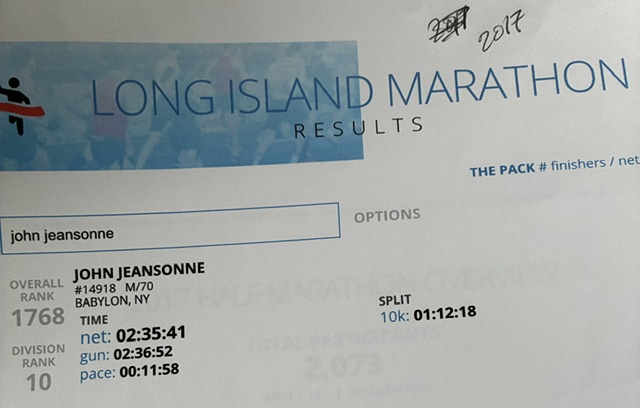
There were another 500 or 600 words describing my half marathon (attempted and completed) that day. I’m just an old recreational plodder, never fleet of foot, but that bit of bass-ackward A.I. “reporting” tests out my hypothesis that Artificial Intelligence—dictionary definition of “artificial:” Not real. Bogus. Counterfeit. Fake.—is not to be trusted.
I came to this conclusion, perceived in some circles as 18th Century thinking, long before stumbling upon the online half-marathon example. During my just-concluded 17-year teaching gig at Hofstra University, more than one case of a student turning his sports journalism assignment over to A.I. reared its head. Which prompted me to recall the “Missouri Method” from my days apprenticing at the University of Missouri Journalism School, where students were expected to “learn by doing.”
If that’s the ideal approach, and I certainly subscribe to it, how might a student learn anything—reporting, researching, fact-checking, writing—if he has A.I. doing the doing?
When Dartmouth College provost Santiago Schnell last month was investigated for publishing A.I.-generated articles under his name, his defense was that he only used A.I. “for language refinement, copyediting, improving clarity and organization and making writing processes more efficient.” (As if there were anything else to creating a writing exercise than those specific actions.)
My A.I.-rejection beliefs have been bolstered further by a recent essay from New York Times opinion writer Jessica Gross, who polled teachers about experiences with A.I. In one instance, middle school English students, assigned to research prophets, appeared to learn from A.I. “jewels such as ‘the Christian prophet Moses got chocolate stains out of T-shirts,’” Gross wrote. (As opposed to getting water out of a rock?!) The kids didn’t think to question that.
Also in defense of what may be a Troglodyte A.I. backwardness on my part, I cite comments from Syracuse University creative writing professor George Saunders, four-time winner of the National Magazine Award for fiction, from a recent Substack post.
“Writing,” Saunders said, “is the most precious way one person can communicate their essence to another person. I’ve spent a lifetime trying to get better at making myself present in my writing. Why would I want to sacrifice even one iota of that [by outsourcing the work to A.I.]? Not even in an email and certainly not in a short story or novel.
“Who are we ceding our authority to, exactly, when we let A.I. write for us?” Saunders asked. “By my definition of writing, writing with A.I. isn’t. Isn’t writing.”
Just, I would argue, that reporting with A.I. isn’t reporting. Maybe the rush to have A.I. do our chores, Saunders concluded, is “like so many things these days, we seem to be doing it because . . . it can be done.”
I just know that lately having A.I. ads appear on my iPad when I’m playing solitaire, offering to do everything from getting me a job to planning a vacation to washing the dishes; having A.I.’s “suggested replies” materialize at the end of emails to me, are just more maddening developments motivating me to scheme a way to get those robotic hands out of my life.
For real.