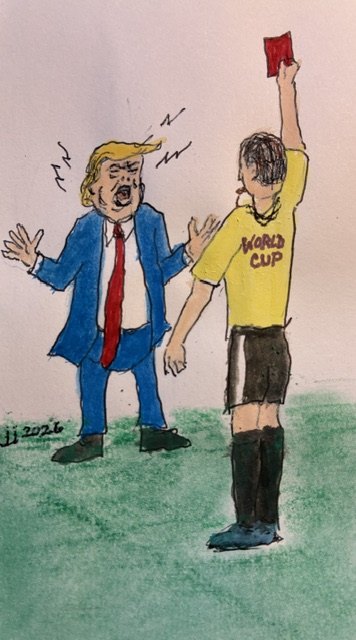
GOAL. The World Cup format of grouped round-robin play before single elimination matches gives everybody a chance to get rolling and enjoy the opportunity to be part of massive global event. And builds tension toward the knockout phase.
YELLOW CARD. Soccer’s insistence on labeling a score on a deflected shot an “own goal,” somehow crediting to the defender who last touched the ball instead of that defender’s opponent, the fellow who actually initiated the shot and whose mates benefit on the scoreboard. And “own goal” is not necessarily a botched play and therefore thoroughly fails to describe how the score was created. Compare that statistical failure to the recent Stanley Cup overtime score by Las Vegas’ Shea Theodore, when his shot bounced off the boards, off Carolina winger Jordan Martinook’s stick and off Carolina goalie Brandon Bussi’s skate and into the net. Theodore, rightfully, was credited with the goal. Not the last-man-to-touch-it: Bussi. There is such a thing as a pin-ball wizard, who deserves the kudos for a successful attack.
GOAL. Old goalkeepers from tiny World Cup debut nations, giving us terrific athletic drama as well as a glimpse of little noticed lands and cultures. Curacao’s Eloy Room, 37, produced a World Cup-record 15 saves in a scoreless tie against Ecuador. (Curacao is a Caribbean Island within the kingdom of Netherlands, with only 156,000 residents who often are annoyed that foreigners only are aware of neighboring Aruba.) Then there is Cape Verde’s 40-year-old Josimar José Évora Dias, who goes by Vozinha—Portuguese for “Little Granny”—who shut out former Cup champion Spain and followed that with a 2-2 tie against two-time Cup champion Uruguay. Little Granny is so-called because he was raised by his grandparents. (Cape Verde—Cabo Verde in Portuguese—is a volcanic archipelago of 10 islands off Africa’s West Coast, first settled by Portuguese sailors, strategically positioned to have given it a significant role in the transatlantic slave trade during the 16th and 17th centuries.)
GOAL. Argentine superstar Lionel Messi’s ability to essentially play possum—walking, walking, walking around the pitch while his teammates defend, organize offensive build-ups—only to materialize at just the right instant, in just the right spot, with the ball, to repeatedly demonstrate an uncanny ability to conjure a score. Seemingly out of thin air.
RED CARD. The Trump administration’s repeated actions throwing sand into the gears of a global party: Withholding visas from various international fans; refusing to admit to the U.S. a soccer official from Somalia as well as several Iran team officials; ordering the Iranian team, whose games were in Los Angeles and Seattle, to relocate its original training/hotel base in Arizona to Mexico.
YELLOW CARD. Miami police reflected the Trump’s inhospitable agenda. When the Tartan Army of Scottish fans, who had charmed Boston—singing, dancing, bagpiping and partying in kilts when their team played two matches in Foxborough—arrived in Florida for their third game, local cops scuttled the Scots’ giddy ritual of placing orange traffic cones on the heads of public statues. In Massachusetts, the Scots had been embraces for their behavior and enthusiasm (and spending lots of money in pubs), as well as the coning thing.
GOAL. Reports of U.S. communities welcoming international teams and their fans, mixing with players at their training sites, hotels and restaurants. It’s the DEI ideal, uplifting antidotes to spreading xenophobia and a measure of hope that U.S. citizens can make America friendly again to outsiders. As with Scotland’s Tartan Army of fans, Norway’s followers who delighted locals with their public “Viking row.”
GOAL. Group L’s opening match between England and Croatia—won by England, 4-2—was about as theatrical as the sport can be and set the tournament tone. Goalie saves, penalty kicks, indefatigable runs up and down the pitch, another look at England’s brilliant striker Harry Kane, who can do with his feet—passing, shooting, defending—what most athletes can’t produce using both hands. Well, some athletes can do what Kane does: Messi, France’s Kylian Mbappe, Portugal’s Cristiano Ronaldo, Norway’s Erling Haaland, Spain’s 18-year-old Lamine Yamal, whose goal against Saudi Arabia made him only the second player that young to score the World Cup’s opening goal. (Pele was 17 when he did so in 1958.)
GOAL. Team kits. (What Americans call uniforms). The best are creative versions of national identification, such as this year’s U.S. flaggish shirt with a waying red stripe and Norway’s equally unmistakable red flag shirt, a white- bordered navy Nordic cross. Ironically, the Yanks’ first match was against Paraguay, which has a remarkably similar “home” kit with vertical red stripes though, to avoid total confusion, Paraguay was attired in its “away” shirts, a swirling mix of “new Navy” and “tropical blue” color. Argentina was nattily attired in its classic Albiceleste, the white-and-sky-blue stripes that mimic Argentina’s flag; Croatian in the red-and-white checkerboard from that nation’s coat of arms; Germany with its traditional black, red and yellow stripe on white; Brazil in yellow shirts, as always.
RED CARD. FIFA, soccer’s global governing body, banned Haiti’s kits hours before the team’s opening match because the shirt featured a small flag-raising illustration from the 1803 Battle of Vertieres, when self-liberated slaves of Haiti defeated Napolean Bonaparte’s forces to secure independence as the world’s first Black republic. FIFA called that “forbidden political imagery,” though FIFA president Gianni Infantino has been cited for “repeated breaches” of the organization’s duty of political neutrality, all in relation to the FIFA president’s public championing of President Trump. That included the bogus, first-of-its-kind FIFA “peace prize” Infantino presented Trump last winter as he has enthusiastically embraced the man who started a war in Iran, seized Venezuela’s president and vowed to militarily intervene in Greenland and Cuba.
RED CARD. U.S.-centric pre-tournament claims that “nobody cares” about the World Cup, widely argued by many American closed-door advocates, have proved to be just as ill-informed as similar rants leading up to the last time the event was in the United States in 1994. The ’94 tournament set a still-standing Cup attendance record of 3.6 million—68,991 per game—with the current Cup on pace to shatter that mark, in spite of FIFA’s roundly criticized dynamic pricing (rip-off), the Trump administration travel restrictions and building anti-American sentiment overseas. Facts on the ground: A Reuters analysis cited stadiums being 99.6 percent full. This is a hyphenated nation; every team has American citizen with roots in its country. National flags are being displayed by fans from their home nations or, in many cases, the land of their ancestors. The World Cup reminds of the positive influence of immigrants.